How to Book Meetings on Autopilot with AI (2026 Step-by-Step Guide)
Book meetings automatically with AI: detect buying signals, run cross-channel sequences across LinkedIn, X, Instagram, and email, and let AI close the booking.
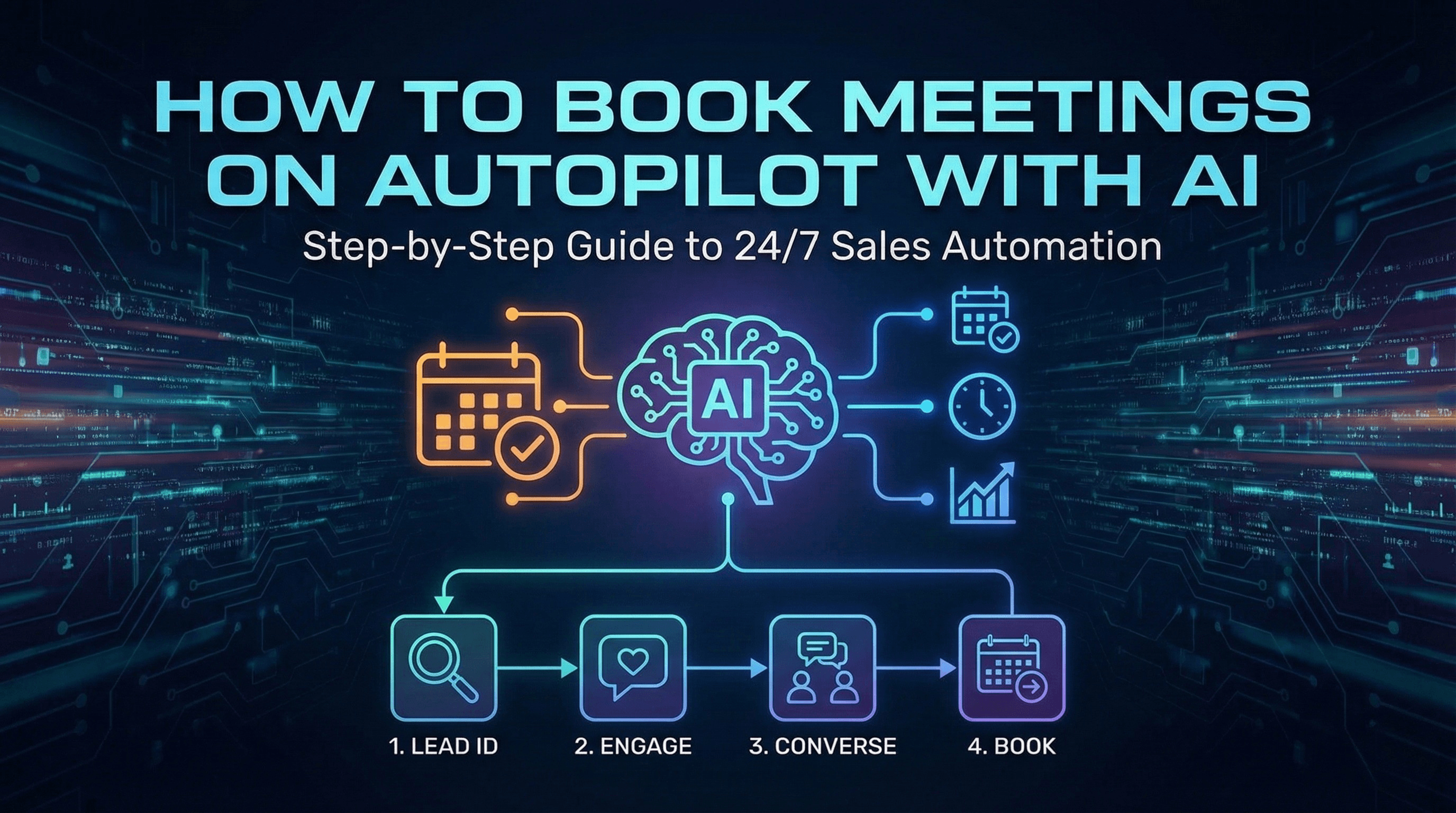
To book meetings automatically with AI, you connect your outreach channels, define who you sell to, and let an AI buyer engine watch for buying signals, write personalized messages across LinkedIn, X, Instagram, and email, handle replies and objections in real conversation, and drop a calendar link the moment a prospect is ready. The meeting lands on your calendar without you touching the keyboard.
That is the short version. In 2026, AI-powered systems book qualified sales meetings 24/7: no cold calling, no hours crafting outreach, no manual follow-ups. Just ready-to-close conversations with prospects who actually want to talk to you. The AI SDR market has exploded to $4.12 billion and is projected to reach $15.01 billion by 2030, and companies using AI sales tools are 3.7 times more likely to hit quota according to Gartner.
This step-by-step guide shows exactly how to set up AI meeting booking that works while you sleep, from defining your ideal customer to watching qualified prospects land on your calendar without lifting a finger.
Table of Contents
- Why AI Meeting Booking Matters in 2026
- How AI Meeting Booking Actually Works
- Step-by-Step: Set Up AI to Book Meetings Automatically
- Real Results: What AI Meeting Booking Delivers
- Common Mistakes to Avoid
- Best Tools for AI Meeting Booking
- Key Takeaways
- FAQ
Why AI Meeting Booking Matters in 2026
The traditional sales development model is breaking. SDRs spend 3+ hours daily on manual prospecting, crafting messages, and following up. Most of that time produces zero meetings. Meanwhile, the cost of hiring, training, and retaining SDRs keeps climbing.
AI changes everything.
The Numbers Don't Lie
The shift to AI-powered sales is happening faster than most realize:
- 82% of organizations plan to integrate AI agents into business operations within the next 1 to 3 years
- AI saves sellers 2 hours per day on manual tasks, roughly 25% of their working time
- Sellers using AI tools are 3.7x more likely to meet quota compared to those who don't
- The AI agent market is growing at 46.3% CAGR, from $7.84 billion in 2025 to $52.62 billion by 2030
- Single operators using automated outbound are generating 150+ qualified meetings per month
Timing Beats Targeting
The biggest unlock in 2026 is not a new channel. It is timing. The same message that gets ignored on a random Tuesday gets a reply when it lands at the exact moment a buyer is looking. That is why signal-driven outbound now beats list-spray outbound: you reach buyers at the moment of intent instead of blasting a cold list and hoping.
A buyer who just tweeted "anyone recommend a tool for X," posted about a hiring spike, announced funding, or started openly evaluating tools is a different prospect than a name on a static list. AI meeting booking works best when it watches for those signals across every channel at once and acts within minutes. For a deeper look, see our guide on why timing beats messaging in B2B outbound and how to detect buyer intent on LinkedIn and X before competitors.
Multichannel, Not Single-Channel
While everyone floods LinkedIn and email inboxes, the smartest operators now run one sequence across four channels at once: LinkedIn, X (Twitter), Instagram, and email. Decision makers are active in different places, and the platform where a buyer first shows intent is rarely the only place to reach them.
The problem with manual outreach is that it doesn't scale across channels. You can't personally engage hundreds of prospects on four platforms, remember every conversation, and follow up at the right time. AI solves this. An AI agent warms up prospects through genuine engagement, initiates personalized conversations on whichever channel fits, qualifies interest, and books meetings directly into your calendar. All on autopilot.
How AI Meeting Booking Actually Works
Before diving into setup, let's understand what's happening under the hood. Modern AI meeting booking systems aren't fancy autoresponders. They're autonomous agents that detect, adapt, and learn.
The Four Components
Every AI meeting booking system has four core components working together:
1. Signal Detection and Lead Identification The AI finds prospects who match your ideal customer profile and, more importantly, watches for the moment they signal intent. Platforms like Autoreach monitor 20+ signal types 24/7 with under 2 minute detection latency: pain points, hiring spikes, funding announcements, tool-evaluation conversations, role and job changes, company-level "heat," and direct intent like "anyone recommend a tool for...". Every lead is then scored by fit, intent, and timing into a single Buyer Score so the system knows who to contact first.
2. Engagement Layer Before any sales conversation, the AI warms up prospects through authentic engagement: likes, thoughtful replies, story views, and genuine interactions that build familiarity. This transforms cold outreach into warm conversations.
3. Conversation Engine When prospects are warmed up, the AI initiates personalized conversations. Unlike static templates, modern AI adapts each message based on the prospect's bio, recent activity, the signal that flagged them, and the live conversation context. It handles objections, answers questions, and guides toward a meeting. The best systems let you see and edit every reply before it sends, so the AI sounds like you, not like a bot.
4. Calendar Integration Once a prospect expresses interest, the AI books the meeting. It connects to Calendly, Cal.com, HubSpot, or your preferred scheduling tool, handles time zones, proposes specific times or shares a link, and confirms appointments automatically.
AI Agents vs. Basic Automation
The key difference between true AI meeting booking and basic automation is adaptability. Basic automation sends the same message to everyone and breaks when prospects respond unexpectedly.
AI agents powered by modern language models can:
- Understand context and intent from prospect responses
- Adapt messaging in real time based on the conversation
- Handle objections and answer questions naturally
- Qualify prospects through intelligent dialogue
- Know when to push for a meeting vs. nurture longer
This is the difference between a robot and a digital teammate.
Step-by-Step: Set Up AI to Book Meetings Automatically
Here's exactly how to set up an AI system that books meetings while you sleep.
Step 1: Define Your Ideal Customer Profile (ICP)
Your AI is only as good as the targets you give it. Garbage in, garbage out.
Before launching any automation, define your ICP with specifics:
Demographics:
- Industry or vertical
- Company size (employees or revenue)
- Geographic location
- Job titles of decision makers
Behavioral Signals:
- Keywords they use in their bio or posts
- Accounts they follow
- Topics they engage with
- Problems they discuss publicly
Example ICP for a fractional CFO offer:
- Founders and CEOs at venture-backed startups
- 10 to 100 employees
- Recently raised a seed or Series A round
- Posting about runway, hiring, or financial planning challenges
AI meeting booking works for founders, builders, consultants, agencies, recruiters, and anyone who sells services and needs clients. That includes indie founders and builders, fractional executives (CFO, CTO, GTM), executive recruiters, fundraising advisors, boutique agencies, and B2B service providers. The more specific your ICP, the more qualified your meetings. If you want a head start, Autoreach's free, no-login Buyer Signal Scan lets you paste any company website and get named decision makers with verified LinkedIn profiles plus a suggested messaging angle per person, in about 20 seconds.
Step 2: Choose Your Outreach Channels
AI can book meetings across multiple channels, and in 2026 the winning move is to run them together rather than pick just one. Each channel has trade-offs:
LinkedIn:
- Professional context, clear B2B intent
- Strict connection limits and automation detection
- Best for decision-maker reach
X (Twitter):
- Less saturated, more authentic conversations
- Decision makers actively engage in public
- Natural warm-up through replies and likes
Instagram:
- Strong for founder-led, creator, and agency audiences
- DMs and story interactions feel personal
- Underused for B2B, so less competition
Email:
- Highest volume potential and universal reach
- Requires domain warming and deliverability management
- Smart routing matters: Gmail-to-Gmail and Outlook-to-Outlook lands better
The strongest setups put all four channels into a single sequence so the AI reaches each buyer where they already pay attention. If you sell heavily on one platform, you can still satisfy that intent. See our deep dive on Twitter and X lead generation and how smart companies use X for B2B sales for the single-channel playbook.
Step 3: Set Up Lead Discovery and Signal Monitoring
With your ICP defined and channels chosen, it's time to build your prospect flow. The goal is not just a static list. It is a live stream of people showing intent.
Follower and Audience Extraction: Pull followers from accounts your ideal customers follow. If a competitor has 50,000 followers, that's 50,000 warm prospects who've already shown interest in solutions like yours. See how to extract followers from any Twitter account.
Keyword and Signal Monitoring: Set up listeners for the language your prospects use. When someone posts "looking for a better CRM" or "need help with lead generation," the AI captures them instantly and scores the intent.
Intent and Heat Scoring: Advanced systems analyze context to prioritize high-intent leads. Someone openly complaining about a problem you solve, or whose company shows hiring and funding "heat," is worth far more than someone casually mentioning the topic. Autoreach scores every lead by fit, intent, and timing so your AI works the hottest prospects first.
Growth Loop Engine: Outbound AI agents create posts and reels, comment, like, and follow in your niche. Inbound AI agents then capture anyone who engages, likes, comments, replies, or views a story, enrich them, score them, and auto-enroll the qualified ones into outreach. This runs on LinkedIn, X, and Instagram, turning your own content into a self-feeding pipeline.
Step 4: Configure Your Warm-Up Sequence
This is where most people fail. They skip straight to DMs and get ignored or banned.
Warm-up is essential for two reasons:
- Account Safety: Platforms detect and penalize accounts that suddenly blast DMs to strangers
- Response Rates: Prospects respond 3 to 5x more when they recognize your profile
Typical Warm-Up Timeline:
| Days | Action | Purpose |
|---|---|---|
| 1-3 | Like 2 to 3 of their posts | Get on their radar |
| 4-5 | Leave thoughtful replies | Build familiarity |
| 6-7 | They start recognizing you | Warm relationship |
| 8+ | Send personalized DM or email | Warm outreach, not cold |
Your AI should handle this entire sequence automatically, building genuine engagement before any sales conversation begins. Account safety also depends on the infrastructure underneath: browser-grade TLS fingerprinting that is indistinguishable from a human at the packet level, per-account behavioral profiles, human-like delays, typing simulation, automatic cooldowns, and a dedicated ISP proxy. For more, read how to warm up your account before outreach and how to automate DMs without getting banned.
Step 5: Create Your AI Conversation Flow
This is where AI truly shines. Instead of static templates, you're creating conversation frameworks the AI adapts in real time.
Opening Message Framework:
[Personalized observation about their profile/content/signal]
[Connection to the problem you solve]
[Simple yes/no qualification question]
Example: "Hey Sarah, loved your thread on scaling outbound. The point about personalization at scale really resonated. We've been working on something that solves exactly that. Is this something you're actively exploring right now?"
Setting Qualification Criteria:
Tell your AI what makes a qualified meeting:
- Confirmed decision maker or influencer
- Acknowledged the problem exists
- Expressed interest in learning more
- Has budget and authority indicators
Handling Objections:
Modern AI handles common objections in stride:
- "Not interested" leads to a graceful exit and a nurture for later
- "Send more info" leads to sharing value, then re-engaging
- "What's the price?" leads to qualifying budget and pivoting to a meeting
- "Maybe later" leads to a timed follow-up sequence
The best platforms make this a glass box, not a black box. With Autoreach's Conversation Simulator you can see and edit every AI reply before it sends, A/B test prompts side by side, and edit the prompt per offer and per sequence. Voice training learns from your past best DMs so replies sound like you. You stay in control while the AI handles volume.
Step 6: Connect Your Calendar
The final piece is seamless scheduling. Your AI needs direct access to book meetings without human intervention.
Supported Integrations:
Most AI meeting booking tools integrate with:
- Calendly: most popular, easy setup
- Cal.com: open-source alternative
- HubSpot Meetings: if you're in the HubSpot ecosystem
- Google Calendar: direct calendar access
Configuration Checklist:
- Set available meeting times
- Define meeting duration (15, 30, or 60 minutes)
- Configure buffer time between meetings
- Set time zone handling (prospect's local time)
- Create confirmation and reminder sequences
When a prospect says "yes," your AI shares the booking link or proposes specific times. No human touch required.
Step 7: Launch and Monitor
Start conservative. Scale gradually.
Launch Protocol:
- Week 1: 10 to 15 new prospects per day, monitor for issues
- Week 2: Scale to 25 to 30 if metrics look healthy
- Week 3: Push toward 50+ with proven messaging
- Ongoing: Optimize based on data, test new approaches
Key Metrics to Track:
| Metric | Target | What It Tells You |
|---|---|---|
| Warm-up completion rate | >90% | Lead quality and targeting |
| DM response rate | 15 to 30% | Message quality |
| Positive response rate | 5 to 10% | Qualification accuracy |
| Meeting book rate | 2 to 5% | Full-funnel effectiveness |
| Show-up rate | 80%+ | Lead quality |
Optimization Loop:
Review performance weekly. Look for patterns:
- Which ICP segments respond best?
- What messaging gets the highest engagement?
- Where do conversations drop off?
- What objections need better handling?
Feed insights back into your AI configuration. Continuous improvement compounds over time.
Real Results: What AI Meeting Booking Delivers
The numbers from operators using AI meeting booking are striking.
Volume at Scale
Manual SDRs typically book 10 to 20 meetings per month working full time. AI systems operating on autopilot deliver 150+ qualified meetings per month for a single operator. That's not a typo. The 24/7 operation and parallel processing power of AI creates order-of-magnitude improvements. Autoreach users have scored 86,850+ leads, see a 40% reply rate, and book about 2 meetings per day on average.
Conversion Improvements
Businesses implementing AI sales agents report 4 to 7x conversion lifts compared to traditional outreach. The combination of signal-driven timing, warm-up sequences, personalization, and intelligent conversation handling produces dramatically better results.
Cost Efficiency
AI meeting booking typically delivers 70% cost savings compared to human SDR teams. An AI system running 24/7 costs a fraction of a single SDR salary, produces more meetings, and never calls in sick or quits. With bring-your-own-key (BYOK) pricing, your AI usage runs at cost with no markup, typically about $50/month in AI spend.
The Compounding Effect
Unlike human SDRs who plateau, AI systems improve continuously. Every conversation teaches the AI something. Objection handling gets sharper. Personalization gets more relevant. Qualification gets more accurate.
After 90 days of operation, your AI is meaningfully better than when it started. After a year, it's dramatically better.
Common Mistakes to Avoid
Even with powerful AI, these mistakes can sabotage your results.
Starting Too Aggressively
The most common failure mode is launching at full volume immediately. Spam detection will notice, and your account can get restricted or banned. Start slow, prove the system works, then scale gradually.
Poor ICP Definition
If you target everyone, you'll qualify no one. Vague ICPs produce unqualified meetings that waste everyone's time. Be ruthlessly specific about who you want to meet.
Ignoring Signals
Spraying a cold list while ignoring real-time buying signals is the old way. The same message converts far better when it lands at the moment of intent. Let the AI watch for signals and prioritize accordingly.
Skipping Warm-Up
Jumping straight to DMs feels faster but produces worse results. The warm-up sequence isn't optional. It's the foundation of high response rates and account safety.
Generic Messaging
AI can personalize at scale. If your messages read like templates, you're not using the technology correctly. Every opening line should reference something specific about that prospect.
Quantity Over Quality
100 bad meetings are worse than 10 great ones. Configure your AI to qualify aggressively. It's better to book fewer meetings with perfect-fit prospects than fill your calendar with people who'll never buy.
No Human Oversight
AI is powerful but not perfect. Review conversations regularly with a tool that lets you see and edit replies. Spot-check quality. Step in when prospects need human attention. The best systems combine AI automation with human oversight.
Best Tools for AI Meeting Booking
The AI meeting booking landscape is evolving rapidly. The real choice in 2026 is between buying a stack of single-purpose point tools or running one all-in-one buyer engine.
All-in-One: Autoreach
Autoreach is an AI Buyer Engine that replaces lead discovery, signal detection, warm-up, multi-channel sequencing, AI conversations, and meeting booking in a single platform. It detects buying signals across LinkedIn, X, Instagram, and email, scores every lead by fit, intent, and timing, runs cross-channel sequences, and books meetings on autopilot. It ships with both Autopilot (the fully automated web app) and Copilot (a Chrome extension that reads live LinkedIn and X DMs and suggests replies in real time), an an optional dedicated proxy (activation included, then $15/mo), and AI included to start via BYOK.
Single-Channel Point Tools
AiSDR is a comprehensive email autopilot with 323+ data sources for personalization. Starts at $900/month.
Salesforge Agent Frank offers both autonomous and collaborative modes for email outreach.
11x.ai (Alice) is an AI agent focused on LinkedIn outreach campaigns.
Artisan (Ava) claims to handle 80% of BDR workload across LinkedIn and email.
Comparison Table
| Feature | Autoreach | Email AI Tools | LinkedIn AI Tools |
|---|---|---|---|
| Channels | LinkedIn + X + Instagram + Email | Email only | LinkedIn only |
| Signal-driven timing | Yes | Limited | Limited |
| Warm-up automation | Yes | N/A | Limited |
| Lead discovery + scoring | Yes | Varies | Limited |
| Editable AI + live simulator | Yes | No | No |
| Autopilot + Copilot | Both | One | One |
| Dedicated ISP proxy | Optional ($15/mo) | Extra/BYO | Extra/BYO |
| AI usage markup | None (BYOK) | Marked up | Marked up |
| Direct calendar booking | Yes | Yes | Varies |
| Starting price | $99/mo | $500 to 900/mo | $1000+/mo |
The point is not that Autoreach is the cheapest tool on any single line item. It is that matching its four channels, signal detection, warm-up, editable AI, and booking with separate point tools would cost far more than $99/month, before you add a proxy and pay marked-up AI fees. For more head-to-head breakdowns, see our best Twitter automation tools comparison and Tweet Hunter alternatives.
Key Takeaways
- AI books meetings automatically by detecting buying signals, running personalized cross-channel sequences, handling conversations and objections, and dropping a calendar link the moment a prospect is ready.
- Timing beats targeting. Signal-driven outbound reaches buyers at the moment of intent and converts far better than cold-list spray.
- Multichannel wins. A single sequence across LinkedIn, X, Instagram, and email reaches each buyer where they already pay attention.
- Warm-up and account safety are non-negotiable. Genuine engagement plus browser-grade fingerprinting, behavioral profiles, and a dedicated proxy protect your accounts.
- Keep the AI a glass box. See and edit replies, A/B test prompts, and train on your voice so messages sound human.
- All-in-one beats a stack of point tools on cost and coordination. Autoreach runs the full pipeline from signal to booked meeting for $99/month with no AI markup.
Frequently Asked Questions
How does AI book meetings automatically?
AI books meetings by monitoring buying signals across your channels, scoring each lead by fit, intent, and timing, then sending personalized messages that adapt to the conversation. When a prospect shows interest, the AI handles objections and shares your calendar link or proposes specific times, so the meeting books without manual work.
How many meetings can AI actually book per month?
Results vary based on your ICP, messaging, and market. Realistic expectations: 20 to 50 meetings per month with a well-configured system, scaling to 100+ as you optimize. Top performers report 150+ meetings monthly, and Autoreach users average about 2 booked meetings per day. The key factor is lead quality, so more targeted, signal-driven prospects mean higher conversion.
Does it work on Instagram and email too, or just Twitter?
Both, and LinkedIn. Autoreach runs a single sequence across four channels: LinkedIn, X (Twitter), Instagram, and email (Gmail and Outlook with smart routing for deliverability). The AI reaches each buyer on whichever channel they pay attention to, instead of locking you into one platform.
Will AI outreach get my account banned?
Not if done correctly. The critical factors are warm-up before DMing, gradual scaling instead of blasting on day one, and genuine personalization. Autoreach adds browser-grade TLS fingerprinting that is indistinguishable from a human at the packet level, per-account behavioral profiles, human-like delays, automatic cooldowns, and a dedicated ISP proxy, so your accounts stay safe. See how to automate DMs without getting banned.
How much does AI meeting booking cost?
Pricing ranges widely. Single-channel point tools run $500 to $1,500/month. Autoreach is $99/month with all platforms (LinkedIn, X, Instagram, Email) included and every feature, plus an optional dedicated proxy for $15/month. You bring your own AI key with no markup, typically about $20 to $50/month in AI cost. Compare that to a human SDR at $50K to $80K+ in salary plus benefits and overhead. A done-for-you option is also available: $299 setup, then $200 per meeting booked, where the Autoreach team sets everything up in one 30-minute call and runs Autoreach for you across all platforms.
Do I need technical skills to set this up?
No. Modern AI meeting booking tools are built for non-technical users. Setup involves connecting your accounts, defining your ICP through simple forms, customizing prompts, and linking your calendar. No coding required, and Autoreach can be set up in about 30 minutes.
Can AI handle objections and complex conversations?
Modern AI powered by large language models handles objections well, addressing common concerns, answering product questions, and guiding conversations toward meetings. With a live conversation simulator you can see and edit every reply before it sends, and the best systems know when to escalate complex or unusual situations to a human.
What is the difference between Autopilot and Copilot?
Autopilot is the fully automated web app that runs discovery, sequencing, and booking for you. Copilot is a Chrome extension that reads your live LinkedIn and X DMs and suggests replies in real time while you stay hands-on. Same AI, same data, same CRM, so you can switch between hands-off and hands-on whenever you want.
Start Booking Meetings on Autopilot
The future of sales development isn't hiring more SDRs. It's deploying an AI buyer engine that works 24/7, never burns out, and continuously improves.
Here's your action plan:
- Define your ICP with ruthless specificity
- Run all four channels (LinkedIn, X, Instagram, email) in one sequence
- Let signals drive timing so you reach buyers at the moment of intent
- Set up proper warm-up before any outreach
- Configure AI conversations with qualification criteria and edit the prompts
- Connect your calendar for seamless booking
- Launch conservatively and scale based on data
Ready to stop spending hours on manual outreach and start waking up to booked meetings?
Try Autoreach, the AI Buyer Engine that detects buying signals across LinkedIn, X, Instagram, and email, scores every lead by fit, intent, and timing, runs cross-channel sequences, and books meetings on autopilot. One plan, every feature, an optional dedicated proxy (activation included, then $15/mo), and AI included to start. $99/month, set up in 30 minutes, cancel anytime.
Tags
Ready to find buyers worth contacting this week?
Autoreach detects buying signals across LinkedIn, X, Instagram, and email, then books meetings on autopilot.