What is an AI SDR? The Future of Sales Development in 2026
What is an AI SDR? A clear definition, how AI SDR tools work in 2026, real ROI data, top platforms compared, and why signal-driven hybrid sales teams win.
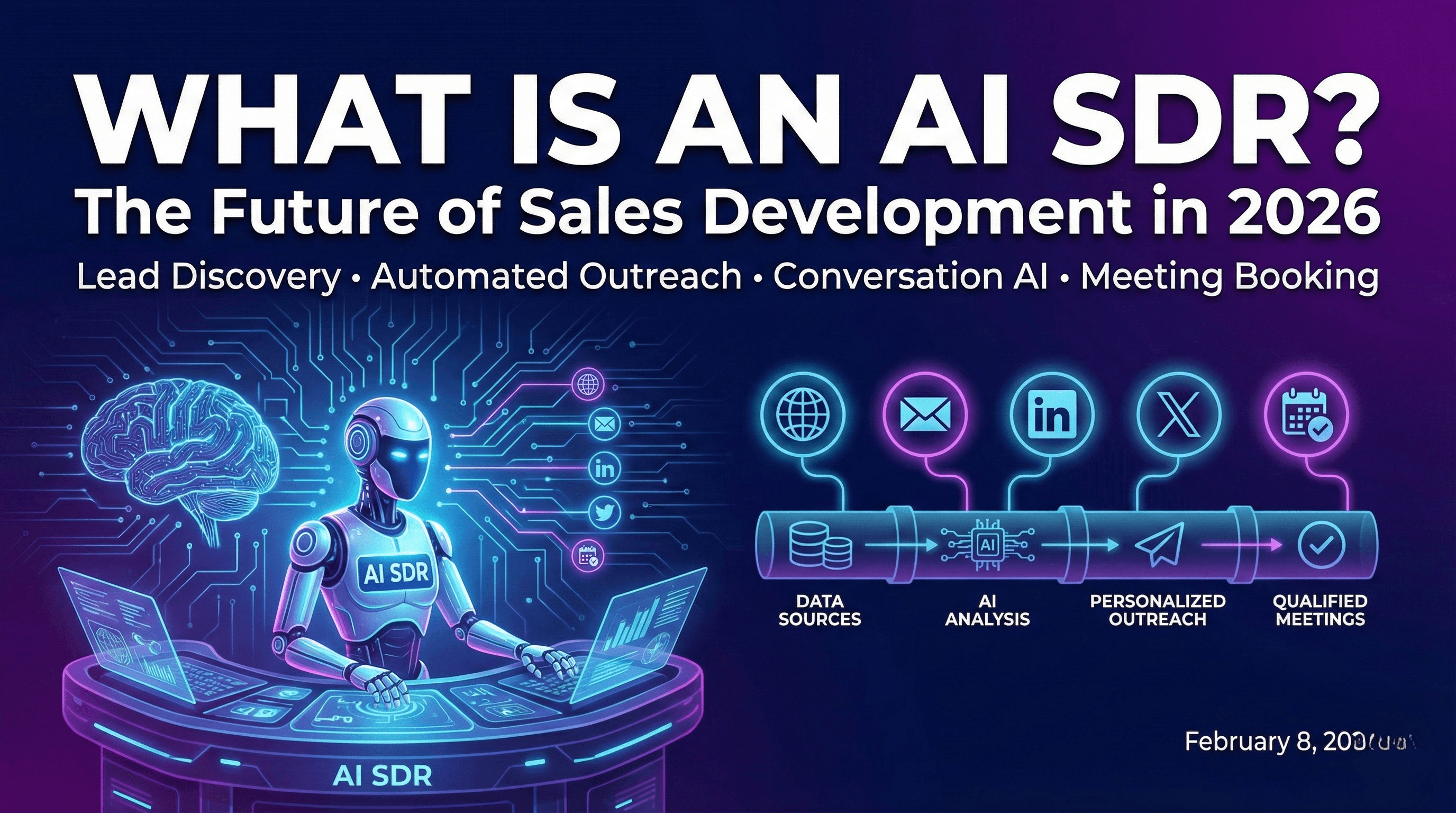
An AI SDR is software that uses artificial intelligence to do the work of a human Sales Development Representative: finding buyers, scoring them by fit and intent, running personalized outreach across channels, handling replies, and booking meetings. Unlike basic automation that blasts the same template to a list, an AI SDR reads context, adapts each conversation, and decides the next best action for every prospect, 24/7.
In 2026, the AI SDR market has reached $4.12 billion and is projected to hit $15.01 billion by 2030, according to MarketsandMarkets. More than 70% of sales teams now use AI in some capacity. SaaStr famously replaced 8 human salespeople with 1.2 humans and 20 AI agents, generating over $1 million in direct revenue in 90 days.
This isn't hype anymore. AI SDR tools are reshaping how companies find leads, run outreach, and book meetings. This guide breaks down exactly what an AI SDR is, how it works, what results to expect, and how to choose the right one for your team in 2026.
Table of Contents
- What is an AI SDR?
- How Does an AI SDR Work?
- AI SDR vs. Human SDR: The Real Comparison
- Why AI SDRs Matter in 2026
- What Can an AI SDR Actually Do?
- The Hybrid Sales Team Model
- Top AI SDR Tools Compared (2026)
- How to Choose the Right AI SDR
- Common Mistakes When Deploying AI SDRs
- Key Takeaways
- FAQ
What is an AI SDR?
An AI SDR (AI Sales Development Representative) is software that uses artificial intelligence to perform the tasks traditionally handled by a human SDR: finding leads, qualifying prospects, running outreach, handling conversations, and booking meetings.
Think of it as a trained digital sales rep that operates 24/7. It identifies potential buyers, reaches out with personalized messages across channels like LinkedIn, X (Twitter), Instagram, and email, responds to replies intelligently, handles objections, and schedules meetings directly on your calendar.
Unlike basic automation tools that send the same templated message to a list, an AI SDR uses large language models and machine learning to understand context, adapt conversations in real time, and make decisions about how to engage each prospect individually.
The key distinction: automation follows scripts. AI SDRs think.
A traditional drip sequence sends Message 1 on Day 1, Message 2 on Day 3, regardless of what happens. An AI SDR reads a prospect's reply, understands their objection, crafts a relevant response, and decides the next best action. If someone says "not right now but maybe next quarter," the AI knows to nurture rather than push for a meeting.
The newest generation goes one step further. Instead of working from a static list, a modern AI SDR is signal-driven: it watches for the moment a buyer shows intent (a pain-point post, a funding round, a hiring spike, a "can anyone recommend a tool for..." question) and reaches out while that intent is fresh. That timing edge is the difference between landing in a warm conversation and getting ignored in a cold inbox.
How Does an AI SDR Work?
Modern AI SDRs operate through five interconnected layers that mirror the workflow of a top-performing human rep.
1. Lead Identification and Signal Detection
The AI scans multiple data sources to find prospects matching your ideal customer profile. This includes CRM data, LinkedIn profiles, X (Twitter) activity, Instagram engagement, company websites, funding databases, job postings, and live buying-intent signals.
The best platforms now monitor 20+ signal types continuously, with detection latency measured in minutes, not days. Signals include pain points, hiring spikes, funding announcements, tool-evaluation conversations, role and job changes, company-level "heat", and direct intent like "anyone recommend a tool for...". Every lead gets automatically enriched with contact information, company data, social profiles, and behavioral context.
2. Prioritization and Scoring
Not all leads are equal. The AI scores every prospect by fit (how closely they match your ICP), intent (how likely they are to buy right now), and timing (whether the moment is right), rolling those into a single composite Buyer Score. A founder who just posted about needing better outreach tools ranks higher than someone who casually follows a competitor account.
This scoring happens continuously. As new signals emerge, lead priorities shift automatically, so your reps always work the hottest accounts first.
3. Personalized Outreach
Using the enriched data, the AI crafts personalized messages for each prospect. Not "Hi FIRST_NAME, I noticed your company COMPANY_NAME..." style personalization. Real personalization that references a specific post, recent company news, a shared connection, or a stated challenge.
The AI operates across multiple channels: LinkedIn DMs, X (Twitter) DMs, Instagram DMs, and email. Cross-channel sequencing lets it warm up a prospect with engagement on one platform before sending a message, then follow up on another, all inside a single coordinated sequence.
4. Conversation Management
This is where AI SDRs separate from everything that came before. When a prospect responds, the AI reads their message, understands the intent, and generates an appropriate reply.
Prospect says they're interested? The AI qualifies and moves toward booking. Prospect raises a pricing concern? The AI addresses it with relevant context. Prospect says they use a competitor? The AI highlights differentiators. Prospect goes silent? The AI follows up with a different angle at the optimal time. The strongest tools let you see and edit every reply before it sends, so the AI never speaks out of brand voice.
5. Meeting Booking
When a prospect is qualified and ready, the AI books the meeting. It shares calendar links, proposes specific times, handles time zone differences, and sends confirmation and reminder messages. The meeting lands on your calendar without any manual intervention.
AI SDR vs. Human SDR: The Real Comparison
The question isn't whether AI SDRs are better or worse than humans. It's understanding what each does best.
Cost Comparison
| Factor | Human SDR | AI SDR |
|---|---|---|
| Annual cost | $75,000 to $100,000 (salary + benefits + overhead) | $1,200 to $24,000/year ($99 to $2,000/month) |
| Ramp time | 3 to 6 months to full productivity | Days to weeks |
| Working hours | 8 hours/day, 5 days/week | 24/7/365 |
| Qualified opportunities/month | 15 to 20 | 40 to 60 |
| Turnover rate | Average SDR tenure is 14 months | Zero |
The math is clear. An AI SDR costs a fraction of a human SDR while producing 2 to 4x the output.
Performance Metrics
Recent data paints a compelling picture:
- AI-led outreach converts at 14.2% compared to 3% for traditional human outreach when fully personalized (AiSDR Industry Report)
- AI SDRs achieve buyer satisfaction scores of 8.4/10 vs. 6.2/10 for human SDRs (Monday.com)
- AI-assisted SDRs book 30 to 50% more meetings than those using manual approaches (ResearchAndMarkets)
- 86% of sales teams using AI report positive ROI within their first year (Sopro)
- SaaStr achieved 5 to 7% response rates with AI agents vs. the 2 to 4% industry average
Where Humans Still Win
AI isn't universally superior. Humans outperform AI in several critical areas:
- Complex, high-stakes negotiations where emotional intelligence matters
- Strategic account development requiring deep relationship building
- Creative problem-solving for unusual prospect situations
- Edge cases that don't fit standard conversation patterns
- Executive-level conversations where authenticity is paramount
Gartner predicts that by 2030, 75% of B2B buyers will prefer sales experiences that prioritize human interaction over AI. The human touch remains essential. The question is where to deploy it.
Why AI SDRs Matter in 2026
Three converging forces make AI SDRs practically mandatory for competitive B2B sales teams in 2026.
1. The Inbox Saturation Problem
Every sales team is sending more outreach than ever. Email inboxes are flooded. LinkedIn connection requests pile up unanswered. The volume of automated messages has driven response rates down across every channel.
The counterintuitive solution isn't sending less. It's sending smarter. AI SDRs combat saturation by identifying the right prospects at the right moment, personalizing every touchpoint, and engaging across less saturated channels like X and Instagram where decision makers are active but fewer sales teams compete.
2. The SDR Talent Crisis
Hiring SDRs is expensive. Training them takes months. The average SDR stays 14 months before leaving. By the time they're fully productive, they're already thinking about their next role.
AI SDRs eliminate this cycle entirely. No recruiting. No training. No turnover. And unlike a departing SDR who takes institutional knowledge with them, an AI SDR's learnings persist and compound.
3. The Shift from Copilots to Autonomous Agents
2024 was the year of AI copilots: tools that assist humans. 2025 and 2026 are the shift to autonomous AI agents that operate independently. The technology has matured enough for AI to handle complete workflows end to end, from lead discovery through booked meeting, with minimal human oversight. The best platforms now ship both modes: a fully autonomous Autopilot for hands-off pipeline, and a Copilot that suggests replies in real time while a human stays in the loop.
Enterprises are moving beyond asking "should we use AI for sales?" to "how many AI agents do we need?"
What Can an AI SDR Actually Do?
Here's a concrete breakdown of what a modern AI SDR handles across the full sales development workflow.
Signal-Based Lead Discovery
AI SDRs don't just work from static lists. They actively find leads showing buying signals in real time. On X, this means identifying people posting about pain points you solve, complaining about competitor products, or asking "anyone recommend a tool for..." On LinkedIn, it means monitoring job changes, company growth signals, funding announcements, and content engagement that indicates buying intent. On Instagram, it means catching the people who like, comment on, and view content in your niche.
The point isn't more leads. It's the right leads at the right moment. (For a deeper dive, see Signal-Driven Outbound: Why Timing Beats Messaging and How to Detect Buyer Intent on LinkedIn and X.)
Multichannel Sequencing
The best AI SDRs operate across multiple platforms in coordinated sequences, all from one flow. A typical sequence might look like:
- Day 1 to 3: Like and comment on the prospect's X or Instagram posts
- Day 4: Send a personalized DM referencing their content
- Day 6: If no response, connect on LinkedIn with a contextual note
- Day 8: Follow up via email with a different value angle (smart routing keeps Gmail-to-Gmail and Outlook-to-Outlook for deliverability)
- Day 10+: Continue nurturing across channels based on engagement signals
This cross-channel approach dramatically outperforms single-channel outreach because prospects see you everywhere, building familiarity and trust before any sales conversation begins.
Autonomous Conversation Handling
AI SDRs manage entire conversation threads autonomously. They handle:
- Interest qualification: Determining if a prospect is a good fit
- Objection handling: Addressing concerns about pricing, timing, competition, or trust
- Value articulation: Explaining benefits relevant to each prospect's specific situation
- Meeting facilitation: Transitioning from conversation to calendar booking
- Nurture sequences: Maintaining relationships with prospects who aren't ready yet
The best tools are glass-box, not black-box: you can read and edit every prompt per offer and per sequence, A/B test variations side by side, and train the AI on your past best DMs so replies sound like you.
Account Warming and Social Presence
Before any outreach begins, AI SDRs build social presence. They engage with prospects' content through likes, thoughtful comments, and follows. This transforms cold outreach into warm conversations and significantly boosts response rates.
The most advanced platforms run a full growth loop: outbound AI agents create posts and reels, comment, like, and follow in your niche, while inbound AI agents capture anyone who engages, enrich and score them, and auto-enroll qualified people into outreach. This runs across LinkedIn, X, and Instagram. (See How to Warm Up Your Twitter Account for the safety fundamentals.)
Lead Enrichment Without Extra Tools
Advanced AI SDRs pull data from multiple sources to build complete prospect profiles: LinkedIn data, X and Instagram profiles, email addresses, company websites, and web searches. What used to require separate tools like Clay or Clearbit is now built directly into the AI SDR workflow.
The Hybrid Sales Team Model
The dominant model emerging in 2026 isn't all-AI or all-human. It's hybrid.
How Hybrid Teams Work
AI handles the top of funnel:
- Prospecting and lead identification
- Initial outreach and qualification
- Routine follow-ups and nurturing
- Data entry and CRM updates
- 24/7 availability across time zones
Humans handle the bottom of funnel:
- Complex conversations requiring emotional intelligence
- Strategic account development
- High-value relationship management
- Creative problem-solving for edge cases
- Closing deals and negotiating contracts
New Roles Emerging
The SDR title itself is evolving. Forward-thinking companies are creating new positions:
- AI SDR Manager: overseeing and tuning AI agent performance, reviewing conversations, optimizing targeting
- Revenue Strategist: designing the systems and workflows that AI agents execute
- Pipeline Architect: building and optimizing AI-powered pipeline generation across channels
The most effective sales teams in 2026 won't just use automation. They'll design entire revenue systems around it.
SaaStr's Real-World Lesson
SaaStr's experience is the most cited case study in AI sales. They deployed 20+ AI agents and went from 8 to 9 human salespeople to 1.2 humans plus AI, generating $1M+ in 90 days.
But here's the part most people miss: managing those AI agents consumes 30% of their Chief AI Officer's time. These systems aren't set-it-and-forget-it. They require ongoing tuning, conversation review, and strategic adjustment. The human role shifts from doing the work to architecting and optimizing the system.
Top AI SDR Tools Compared (2026)
The AI SDR landscape ranges from enterprise platforms costing thousands per month to accessible tools built for founders and small teams.
Tool Comparison
| Tool | Best For | Primary Channels | Starting Price | Key Strength |
|---|---|---|---|---|
| Autoreach | Founders & builders, signal-driven outbound | LinkedIn, X, Instagram, Email | $99/mo | All-in-one: signal detection, scoring, 4-channel sequences, AI conversations, meeting booking; no AI markup (optional proxy $15/mo) |
| 11x.ai (Alice) | Enterprise email/LinkedIn | Email & LinkedIn | ~$5,000/mo | Heavily funded ($76M from a16z), fully autonomous prospecting |
| Artisan (Ava) | Mid-market multi-channel | Email & LinkedIn | ~$2,400/mo | Multi-channel outreach with AI personalization |
| AiSDR | Email-first automation | $900/mo | 323+ data sources for personalization | |
| Apollo.io | Data + sequencing | Email & LinkedIn | $49/user/mo | 275 million verified contacts database |
| Instantly | High-volume cold email | $37/mo | Unlimited email accounts, built-in warming |
What Sets Autoreach Apart
Most AI SDR tools do one slice of the job. Autoreach replaces a whole stack (lead discovery, signal detection, account warmup, multichannel sequencing, AI conversations, and meeting booking) in a single platform. Buying 3 or 4 point tools to match it costs far more than $99/month. Here's what's built in:
- Signal detection: 20+ signal types monitored 24/7 with under 2 minute detection latency, so you reach buyers at the moment of intent
- Buyer Score: every lead scored by fit, intent, and timing into one composite score
- Four channels, one sequence: LinkedIn, X, Instagram, and email (Gmail and Outlook), with smart routing for deliverability
- Conversation Simulator: see and edit every AI reply before it sends, A/B test prompts, fully editable per offer and per sequence (glass-box, not black-box), with voice training from your best past DMs
- Autopilot and Copilot: a fully automated web app plus a Chrome extension that reads live LinkedIn and X DMs and suggests replies in real time, same AI and CRM
- Growth Loop Engine: outbound agents post and engage in your niche, inbound agents capture, enrich, score, and auto-enroll anyone who engages
- Account safety built in: browser-grade TLS fingerprinting, per-account behavioral profiles, human-like delays and typing simulation, and an optional dedicated ISP proxy ($15/month)
- Free Buyer Signal Scan: paste a website and get named decision makers with verified LinkedIn profiles plus a messaging angle per person in about 20 seconds, no login required
Autoreach is built for founders, builders, and professionals who need clients but hate doing outreach manually: indie founders & builders, consultants & advisors, fractional executives (CFO/CTO/GTM), recruiters, agencies, and B2B service providers, anyone who sells services and needs a steady pipeline without a sales team. To date the platform has scored 86,850+ leads, sees a 40% reply rate, and books about 2 meetings per day for active users.
How to Choose the Right AI SDR
Not every AI SDR fits every business. Here's how to make the right choice.
Match the Tool to Your Sales Motion
- If you sell services through warm relationships and social engagement: Choose a tool with strong LinkedIn, X, and Instagram capabilities, signal detection, warm-up features, and conversation AI. Autoreach excels here.
- If you run high-volume email campaigns: Look at Instantly or AiSDR for their email infrastructure and deliverability features.
- If you're enterprise with complex sales cycles: Consider 11x.ai or Artisan for their multi-touch, multi-stakeholder capabilities.
- If you need data first: Apollo.io's massive contact database might be your starting point.
Critical Features to Evaluate
All-in-one vs. a stack of point tools. A single platform that handles discovery, signals, warmup, sequencing, conversations, and booking is almost always cheaper and simpler than wiring together 3 or 4 specialist tools that don't talk to each other.
Account safety. Any tool automating outreach on social platforms needs human-like behavior patterns, proxy support (ideally a dedicated proxy available at a flat monthly rate, not a marked-up extra), and rate limiting. Getting your account banned defeats the purpose.
Personalization quality. Ask for sample AI-generated messages. Do they read like a human wrote them, or like a template with variables filled in? The difference determines your response rates.
Conversation handling. Can the AI actually manage back-and-forth conversations, and can you see and edit what it says? Many tools claim "AI outreach" but only automate the first message. Look for glass-box tools that handle the entire conversation through to booking.
Multichannel support. Prospects live on multiple platforms. Your AI SDR should too. A single sequence that spans LinkedIn, X, Instagram, and email compounds the effect of each touchpoint.
AI pricing. Some tools bake marked-up AI usage into the price. Bring-your-own-key (BYOK) pricing with zero markup is far cheaper at scale, typically about $50/month in actual AI cost.
Pricing transparency. The AI SDR space has some notoriously opaque pricing. Look for tools that show their pricing upfront without requiring a sales call.
Realistic Timeline for Results
Based on real deployment data:
- Week 1 to 2: Setup, account warming, initial outreach begins
- Week 3 to 4: First responses and conversations start flowing
- Month 2: Consistent meeting flow, optimization cycle begins
- Month 3 to 6: Full productivity with compounding improvements
- Month 6+: Mature system delivering predictable pipeline
Companies with clean data and defined ICPs see ROI in 3 to 6 months. Those building from scratch should budget 6 to 9 months.
Common Mistakes When Deploying AI SDRs
Treating AI as Set-and-Forget
The biggest misconception about AI SDRs is that you deploy them once and walk away. Even SaaStr's highly publicized success requires 30% of a senior leader's time to manage. Review conversations. Adjust targeting. Refine messaging. The AI gets better when humans guide it.
Targeting Too Broadly
AI can reach thousands of prospects. That doesn't mean it should. A hyper-specific ICP produces better results than blasting messages to everyone who might be interested. This is exactly why signal-driven targeting matters: quality input produces quality output.
Ignoring Channel Saturation
If every competitor is hammering LinkedIn and email, doing the same thing with AI just adds to the noise. Consider less saturated channels. X and Instagram have a fraction of the automated outreach volume, which means higher response rates and more authentic conversations.
Skipping the Warm-Up Phase
Whether you're warming up a new email domain or a social account, the warm-up phase is non-negotiable. AI SDRs that skip it get accounts flagged, messages filtered, and results killed before they start. (See How to Automate Twitter DMs Without Getting Banned.)
Expecting AI to Fix Bad Positioning
AI SDRs amplify your message. If your value proposition is unclear or your offer doesn't resonate, AI will just deliver that weak message to more people faster. Nail your positioning before scaling outreach.
Not Measuring the Right Metrics
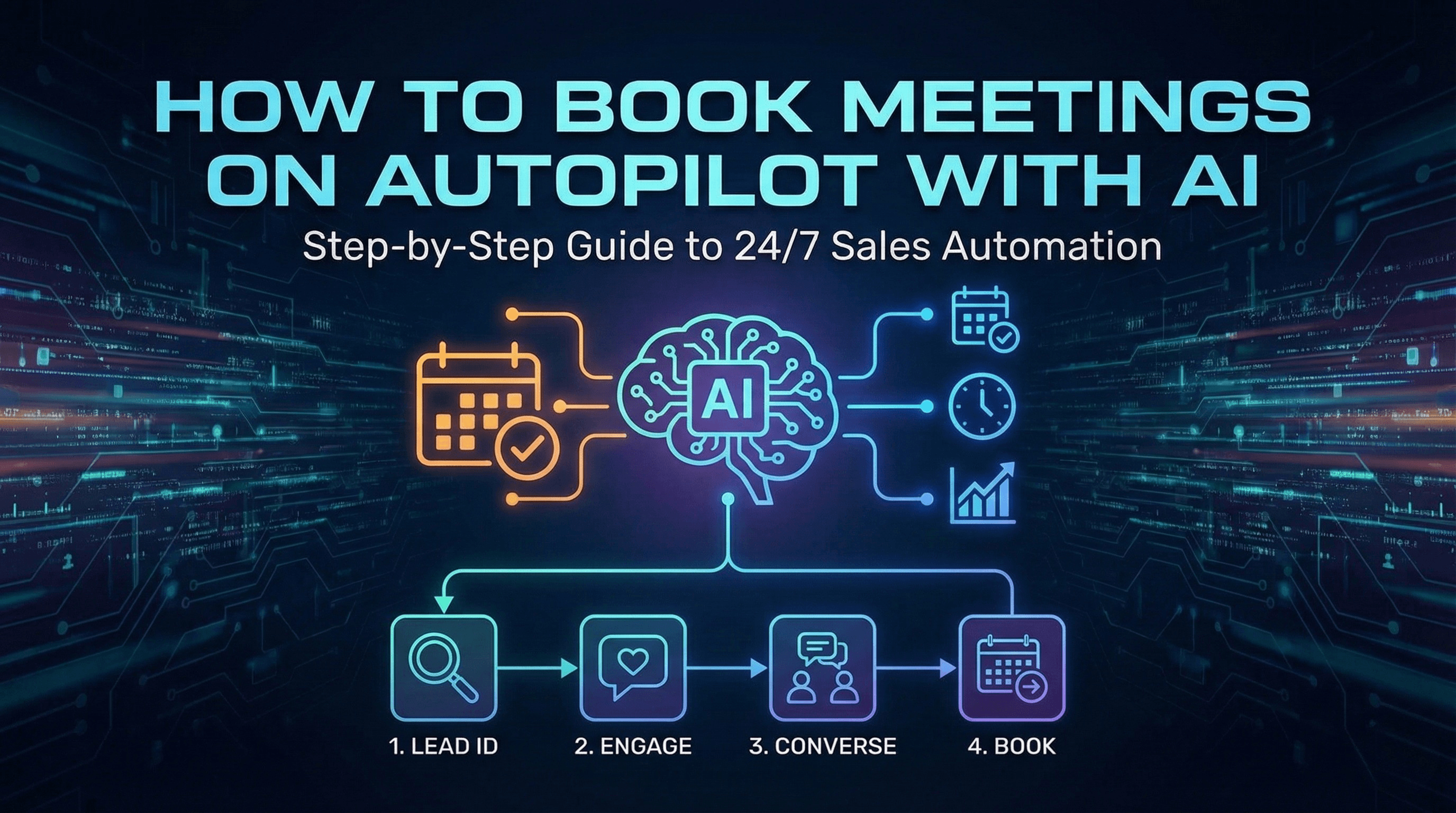
Vanity metrics like "messages sent" don't matter. Track what counts: response rate, positive response rate, meetings booked, meeting show rate, and pipeline generated. These tell you whether the AI is actually driving revenue. (For the booking side, see How to Book Meetings on Autopilot with AI.)
Key Takeaways
- An AI SDR is software that finds buyers, scores them by fit and intent, runs personalized multichannel outreach, handles replies, and books meetings, 24/7, the way a human SDR would but at a fraction of the cost.
- The big leap in 2026 is signal-driven timing: reaching buyers the moment they show intent, not spraying a cold list.
- AI SDRs cost roughly 70 to 80% less than a human SDR while producing 2 to 4x the qualified output, but they are not set-and-forget; they need ongoing tuning.
- The winning structure is hybrid: AI owns the top of funnel, humans own complex conversations and closing.
- Multichannel beats single-channel. The strongest tools run LinkedIn, X, Instagram, and email inside one coordinated sequence.
- Autoreach is an all-in-one AI Buyer Engine for founders, builders, and anyone who sells services and needs clients at $99/month, zero AI markup and an optional dedicated proxy ($15/mo), with both Autopilot and Copilot modes.
Frequently Asked Questions
What does AI SDR stand for?
AI SDR stands for Artificial Intelligence Sales Development Representative. It's software that uses AI and machine learning to automate the tasks of a traditional human SDR: finding leads, running outreach, qualifying prospects, handling conversations, and booking meetings.
How much does an AI SDR cost compared to hiring a human SDR?
A human SDR costs $75,000 to $100,000 annually when you include salary, benefits, training, and overhead. AI SDR platforms range from about $99/month for all-in-one tools like Autoreach to $5,000+/month for enterprise solutions like 11x.ai. Even premium AI SDRs represent a large cost reduction compared to human equivalents, and an all-in-one tool also replaces several point products you'd otherwise pay for separately.
Will AI SDRs replace human salespeople?
Not entirely. The consensus in 2026 is the hybrid model: AI handles top-of-funnel prospecting, outreach, and qualification, while humans focus on complex conversations, relationship building, and closing. Gartner predicts that by 2030, 75% of B2B buyers will still prefer human interaction for key sales moments. AI replaces repetitive tasks, not relationships.
How do AI SDRs handle objections?
Modern AI SDRs powered by large language models can understand objections in context and respond appropriately. Common objections like pricing concerns, timing, competitor comparisons, and trust issues are handled in real time during conversations. The best tools let you read and edit every reply before it sends, and complex or unusual objections can be escalated to a human.
Are AI SDRs safe to use on LinkedIn, X, and Instagram?
Safety depends entirely on the tool. Look for AI SDRs that use human-like behavior patterns, gradual scaling, a dedicated proxy, and account warm-up protocols. Autoreach is built with account safety as a priority, using browser-grade TLS fingerprinting, per-account behavioral profiles, human-like delays, and an optional dedicated ISP proxy ($15/month). Aggressive tools that blast messages without warm-up will get accounts flagged.
Does an AI SDR work on Instagram and email too, or just LinkedIn and X?
Yes. The strongest AI SDRs are multichannel. Autoreach runs LinkedIn, X (Twitter), Instagram, and email (Gmail and Outlook) inside one coordinated sequence, with smart routing that keeps Gmail-to-Gmail and Outlook-to-Outlook for deliverability. That means a single prospect can be warmed on Instagram, messaged on LinkedIn, and followed up by email automatically.
What is the difference between Autopilot and Copilot mode?
Autopilot is a fully automated web app: the AI discovers, scores, sequences, replies, and books meetings hands-free. Copilot is a Chrome extension that reads your live LinkedIn and X DMs and suggests replies in real time while you stay in control. Both use the same AI, the same data, and the same CRM, so you can move between hands-off and hands-on whenever you want.
What results can I realistically expect from an AI SDR?
Based on real deployment data: AI-led outreach converts at 14.2% when properly personalized, compared to 3% for traditional approaches. Expect 2 to 4 weeks before meaningful meeting flow begins, with results compounding over 3 to 6 months. Companies report 4 to 7x conversion improvements and 30 to 50% more meetings booked compared to manual methods. Results depend heavily on ICP quality, messaging, and channel choice.
How long does it take to set up an AI SDR?
Most modern AI SDR platforms are designed for non-technical users. Autoreach is set up in about 30 minutes: you connect your accounts, define your offer and ideal customer profile, configure messaging, and link your calendar. The warm-up period before full outreach takes 1 to 2 weeks. Full productivity typically arrives within 30 to 60 days as the system optimizes.
The Future is Already Here
The AI SDR isn't a future concept. It's the present reality of B2B sales in 2026. Companies that deploy AI for signal detection, scoring, multichannel outreach, and meeting booking are operating at a fundamentally different speed and cost structure than those still relying on fully manual sales development.
The winning formula is clear: let AI handle the volume, the repetition, and the 24/7 grind of top-of-funnel sales. Free your human team to do what they do best, build relationships, solve complex problems, and close deals.
Try Autoreach, the AI Buyer Engine that detects buying signals across LinkedIn, X, Instagram, and email, scores every lead by fit, intent, and timing, runs cross-channel sequences, and books meetings on autopilot. One plan, every feature, an optional dedicated proxy (activation included, then $15/mo), and AI included to start. $99/month, set up in 30 minutes, cancel anytime.
Tags
Ready to find buyers worth contacting this week?
Autoreach detects buying signals across LinkedIn, X, Instagram, and email, then books meetings on autopilot.