Twitter Cold DM Templates That Actually Get Replies (2026)
Twitter cold DM templates that get replies in 2026. 15+ proven X DM scripts, personalization formulas, and benchmarks for 25 to 40% response rates.
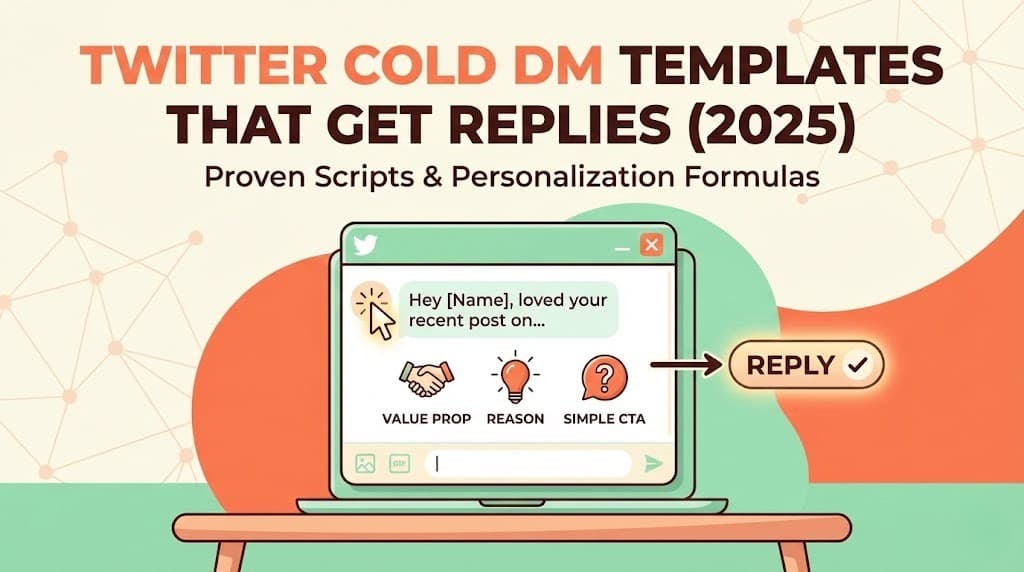
The best Twitter cold DM templates in 2026 lead with one genuinely specific detail about the recipient, name the value in a sentence, and close with an easy yes or no question. Personalized cold DMs on X reach 25 to 40% response rates, while generic copy-paste blasts sit at 1 to 3%. The template is just a frame. The personalization and timing are what earn the reply.
Sending the same message to hundreds of prospects no longer works. X's spam detection is smarter, and recipients spot a template from the first few words. What still works is outreach that feels human, leads with value, and reaches people when they are actually in market.
In this guide you get 15+ proven Twitter cold DM templates organized by use case, plus the exact formulas and personalization strategies that turn cold outreach into conversations. Everything here works manually, and at the end we show how Autoreach generates and personalizes these same messages across X, LinkedIn, Instagram, and email so you can scale without losing the human touch.
Table of Contents
- Why Most Twitter Cold DMs Fail
- The Anatomy of a High-Converting Twitter DM
- 15 Twitter Cold DM Templates That Get Replies
- Twitter DM Templates by Use Case
- How to Personalize Your Twitter DM Templates at Scale
- Twitter Cold DM Response Rate Benchmarks (2026)
- Common Mistakes to Avoid
- Key Takeaways
- FAQ
Why Most Twitter Cold DMs Fail
Before we dive into templates that work, let's understand why most Twitter cold DMs get ignored. Avoiding these mistakes is half the battle.
Generic Openings
"Hey, I noticed you're in [industry]..." is not personalization. Everyone knows this is a template. Your first sentence needs to reference something specific about the recipient that proves you actually looked at their profile.
Pitching Too Soon
Opening with your offer before establishing any rapport kills response rates instantly. People buy from people they trust. Your first DM should start a conversation, not close a sale.
No Real Personalization
Just inserting someone's name or company isn't personalization. Real personalization references their recent tweets, a specific accomplishment, or something unique to them that you couldn't know without reading their content.
Bad Timing
A perfect message sent to someone who isn't in market still gets ignored. The highest-reply DMs land right after a trigger: a hiring spike, a funding announcement, a tool-evaluation thread, a role change, or a public "anyone recommend a tool for..." question. Timing the outreach to a real buying signal beats any clever opener. This is why signal-driven outbound consistently outperforms cold-list spray.
Too Long
Wall-of-text DMs don't get read. You have about 3 to 4 seconds to capture attention before they move on. Keep your Twitter DM templates under 5 sentences maximum.
Links in the First Message
Including links in your first cold DM is the fastest way to look like spam, both to the recipient and to X's detection systems. Save links for after you've gotten a response.
The Anatomy of a High-Converting Twitter DM
Every effective Twitter cold DM template follows this formula:
[Personalized Opener] + [Why You're Reaching Out] + [Value Proposition] + [Simple CTA]
Let's break this down:
Personalized Opener (1 sentence): Reference something specific you noticed about them. A recent tweet, their bio, a project they shipped, or content they created.
Why You're Reaching Out (1 sentence): Briefly explain the connection between what you noticed and why you're messaging.
Value Proposition (1 to 2 sentences): What's in it for them? What problem do you solve or value do you provide?
Simple CTA (1 sentence): End with an easy yes or no question. Don't ask them to explain their entire business or schedule a call immediately.
The Power of Qualification Questions
The best Twitter cold DMs end with a quick qualification question that does double duty: it's easy for the prospect to answer AND it tells you whether they're worth pursuing.
Great qualification questions:
- "Is this something you're actively working on?" (Qualifies timing)
- "Is this a priority for your team right now?" (Qualifies urgency)
- "Would this be worth a quick conversation?" (Qualifies interest)
- "Are you the right person for this, or should I reach out to someone else?" (Qualifies decision-maker)
These yes or no questions require minimal effort to answer, which increases response rates. But more importantly, the answer tells you immediately whether to invest more time in this prospect. A "yes" means they're qualified and interested. A "no" or "not right now" saves you from wasting time on someone who was never going to convert.
The key principles:
- Keep it under 5 sentences total
- No links in the first message
- Reference something specific about them
- End with a yes or no qualification question
- Make it easy to respond in under 10 seconds
15 Twitter Cold DM Templates That Get Replies
Here are 15 proven Twitter cold DM templates organized by approach. Customize each one with genuine personalization for your specific prospect.
The Compliment Opener Templates
These templates work by leading with genuine appreciation for something the prospect created or accomplished.
Template #1: The Content Appreciation
Hey [Name], just read your thread on [specific topic] and your point about
[specific insight] really stood out. I've been thinking about that exact
problem in my own work.

I help [target audience] with [specific result]. Would you be open to
a quick chat about how we might work together?
Template #2: The Achievement Recognition
[Name], congrats on [specific achievement: funding round, product launch,
milestone]. That's huge. I've been following [Company] since [specific
timeframe/event].

We help companies like yours [specific outcome]. Is this something
you're actively working on?
Template #3: The Thought Leadership Appreciation
Your take on [specific topic from recent tweet] was spot on. Especially
the part about [specific detail]. Not many people talk about this honestly.

I work with [audience type] on [related problem]. Would love to exchange
ideas if you're open to it.
The Value-First Templates
These templates offer something valuable upfront without asking for anything in return.
Template #4: The Quick Win Offer
Hey [Name], I was looking at [Company's website/product/content] and
noticed a quick win you might be missing with [specific observation].

I put together a 2-minute Loom walking through what I'd change. Want
me to send it over?
Template #5: The Free Audit
[Name], I audited your [specific: landing page, Twitter strategy,
content approach] and found 3 things that could improve [specific
metric] by [realistic percentage].

Happy to share the notes if useful. No pitch, just thought it might help.
Template #6: The Resource Share
Hey [Name], based on your recent tweets about [topic], I thought you
might find this useful: [brief description of resource, not a link yet].

We put this together for [audience type] dealing with [specific problem].
Want me to send it your way?
The Problem-Solution Templates
These templates lead by identifying a problem the prospect likely faces.
Template #7: The Pain Point Identifier
[Name], I saw you tweeted about [pain point they mentioned]. We've helped
3 other [similar companies/people] solve exactly that by [brief solution].

Would a quick conversation be worth your time to explore this?
Template #8: The Industry Problem
Hey [Name], most [their role: founders, marketers, sales leaders] I talk
to are struggling with [common problem in their space].

We built something that solves this for [specific audience]. Is this
on your radar right now?
Template #9: The Observation-Based Approach
[Name], noticed [Company] is [growing fast/entering new market/scaling].
Usually that means [common challenge that comes with it].

We specialize in helping companies at your stage with exactly this.
Worth a conversation?
The Mutual Connection Templates
These templates leverage shared connections, communities, or experiences.
Template #10: The Shared Community
Hey [Name], we're both in [community/group/following same person]. I've
seen your posts about [topic] and they've been really helpful.

I'm working on something related and would love your perspective. Open
to a quick chat?
Template #11: The Warm Introduction Reference
[Name], [mutual connection] mentioned you're the go-to person for
[specific expertise]. I'm working on [related project] and could use
some guidance.

Would you have 15 minutes for a quick call this week?
The Follow-Up Templates
These templates are for following up after no response to your first message.
Template #12: The Value-Add Follow-Up
Hey [Name], following up on my message from last week. Since then, I
actually [did something relevant: wrote an article, built a tool,
analyzed their niche].

Thought you might find it interesting. Still open to connecting?
Template #13: The Direct Follow-Up
[Name], just wanted to bump this in case it got buried. I know you're
busy, so I'll keep it simple: [one sentence value prop].

Worth a quick chat? If not, no worries at all.
The Collaboration Templates
These templates propose mutually beneficial partnerships.
Template #14: The Content Collaboration
Hey [Name], I've got an audience of [X followers/readers] in [niche]
and I'm looking to collaborate with experts like you on [specific
content: podcast, newsletter feature, Twitter thread].

Would you be interested in being featured? I'd handle all the production.
Template #15: The Partnership Proposal
[Name], I think there's an interesting opportunity between [your company]
and [their company]. We both serve [overlapping audience] but in
complementary ways.

Would you be open to exploring a partnership? I have a few ideas.
Twitter DM Templates by Use Case
Different goals require different approaches. Here are Twitter cold DM templates tailored to specific use cases.
For SaaS and Software Sales
Hey [Name], saw [Company] is [specific growth indicator]. When teams
hit this stage, [common problem] usually becomes a bottleneck.

We've helped companies like [similar company] solve this with [brief
solution]. Is this something you're actively looking to improve?
For Agencies and Services
[Name], I've been following [Company] and love what you're building.
I noticed your [specific area: ads, content, SEO] could be driving
even more results.

We help [similar companies] [specific outcome: 2x leads, cut CAC,
scale content]. Worth a conversation?
For Coaches and Consultants
Hey [Name], your content on [topic] really resonates. I work with
[target audience] on [specific transformation] and think there might
be some synergy.

Would you be open to exploring how we might collaborate or refer
clients to each other?
For Partnerships and Collaborations
[Name], both of us serve [overlapping audience] but from different
angles. You focus on [their focus], we focus on [your focus].

I think a partnership could be valuable for both our audiences.
Interested in exploring this?
For Job Seekers
Hey [Name], I've been following [Company] for a while and I'm impressed
by [specific project or value]. I'm a [role] with experience in [relevant
skill] and I'd love to contribute to what you're building.

Would you be open to a quick chat about opportunities on your team?
How to Personalize Your Twitter DM Templates at Scale
Using templates doesn't mean sending identical messages. Here's how to personalize effectively, even when reaching out to hundreds of prospects.
Key Personalization Variables
For each prospect, gather these before sending:
- Recent tweet or thread they posted (within the last 7 days)
- Bio details that signal pain points or goals
- Company news like funding, launches, or milestones
- Content they engage with that reveals interests
- Mutual connections or shared communities
The Warm-Up Strategy
Before sending any DM, engage with their content first:
- Days 1 to 3: Like 2 to 3 of their tweets
- Days 4 to 5: Leave a thoughtful reply on their content
- Days 6 to 7: They start recognizing your profile
- Day 8+: Send your DM (now it's warm, not cold)
This sequence transforms cold outreach into warm introductions, dramatically improving response rates. If your account is new, walk through how to warm up your Twitter account before outreach first so you don't trip spam filters out of the gate.
Using AI for Personalization
Manually researching hundreds of prospects isn't scalable. Autoreach uses AI to write and personalize each message based on the prospect's bio, recent tweets, and live activity, generating a unique opener that references something specific to each person so every message feels hand-crafted even at scale.
What makes this different from a black-box DM bot is the Conversation Simulator: you see and edit every AI reply before it sends, A/B test two prompt variants side by side, and tune the voice per offer and per sequence. The prompts are fully editable and the AI learns from your past best DMs, so the output sounds like you, not a robot. Nothing goes out that you haven't approved.
And because buyers don't live on one platform, the same AI writes and personalizes these messages across X, LinkedIn, Instagram, and email in a single sequence, so a prospect who ignores your DM can pick up the thread on LinkedIn or in their inbox.
Twitter Cold DM Response Rate Benchmarks (2026)
Understanding what "good" looks like helps you optimize your approach. Here are realistic Twitter cold DM response rate benchmarks based on current data.
| Message Type | Response Rate |
|---|---|
| Generic copy-paste messages | 1 to 3% |
| Basic personalization (name + company) | 5 to 8% |
| Genuine personalization (specific reference) | 12 to 20% |
| Warm outreach + personalization | 25 to 40% |
| Signal-timed + personalized (sent at a buying trigger) | 40%+ |
In one documented experiment, 537 automated but personalized DMs generated 121 responses, a 22.5% response rate.
Key factors that impact response rates:
- Warm-up engagement before DMing: +50 to 100% improvement
- Personalized opening line: +200% improvement
- No links in first message: +30% improvement
- Yes or no qualification question as CTA: +25% improvement
- Questions that take under 10 seconds to answer: +40% improvement
- Timing the DM to a real buying signal: the single biggest lever, because you reach people while the problem is top of mind
Common Mistakes to Avoid
Even with great Twitter cold DM templates, these mistakes will kill your response rates.
Sending Identical Messages
X's spam detection catches this immediately. Beyond getting flagged, recipients can tell when they're getting the same message everyone else received.
Including Links in Your First DM
Links in cold DMs look spammy to both X and recipients. Wait for a response before sharing any URLs.
Not Following Up
Most responses come on the second or third message. If you're not following up 3 to 5 days after your initial DM, you're leaving replies on the table.
Pitching Before Building Rapport
Your first message should start a conversation, not close a deal. Save the pitch for after you've established some rapport.
Writing Messages That Are Too Long
If your DM requires scrolling to read, it's too long. Keep it under 5 sentences and respect their time.
Ignoring Their Response Style
Look at how the prospect writes their tweets. Are they formal or casual? Do they use emojis? Mirror their communication style for higher engagement.
Asking Complex Questions Instead of Yes or No
Ending your DM with "What are your biggest challenges with lead generation?" requires the prospect to stop, think, and write a paragraph. That's too much friction. Instead, ask simple yes or no qualification questions like "Is this a priority right now?" The easier it is to respond, the more responses you'll get.
Blasting a Cold List Instead of Timing the Outreach
The biggest waste of good templates is sending them to people who aren't in market. Reaching out the moment someone shows intent (hiring, funding, a tool-evaluation thread) converts far better than working a static list. For the full playbook, see how to detect buyer intent on LinkedIn and X before competitors.
Key Takeaways
- The template is a frame, not the message. One genuinely specific detail in the opener beats any clever script.
- Lead with value, close with a yes or no question. Easy-to-answer CTAs qualify the prospect and lift reply rates.
- No links in the first DM, keep it under 5 sentences, and mirror the prospect's tone.
- Timing beats messaging. A DM sent at a real buying signal outperforms a perfect message sent cold.
- Warm up first, then personalize, then follow up once or twice. Most replies come on message two or three.
- Multichannel wins. Buyers ignore one platform and answer on another, so run X, LinkedIn, Instagram, and email together.
- Autoreach generates and personalizes these DMs across all four channels, and the Conversation Simulator lets you edit every message before it sends.
Frequently Asked Questions
How many Twitter DMs can I send per day without getting banned?
For warmed-up, established accounts, 50 to 75 DMs per day is generally safe. New accounts should stay under 20 per day. Always prioritize quality over quantity, as X's detection systems are sophisticated and penalize spammy behavior. For a deeper walkthrough, read how to automate Twitter DMs without getting banned.
Should I use templates or write custom DMs for every person?
Use templates as a framework, but always customize the opening line with something specific to each prospect. The body of your message can follow a template, but the first sentence must be genuinely personalized. Autoreach automates this by generating a unique, specific opener per prospect that you can still edit before it sends.
When is the best time to send Twitter DMs?
Generally, weekday mornings (8 to 10 AM) and lunch hours (12 to 1 PM) in your target's timezone work best. However, B2B prospects are often active in evenings when they're catching up on X personally. The best time of all is right after a buying signal, so timing the DM to intent matters more than the hour of day.
How do I follow up without being annoying?
Follow up once after 3 to 5 days, adding new value or insight. If still no response, one more follow-up after another week is acceptable. After two follow-ups with no response, move on. Always make it easy for them to say no.
Can I automate Twitter DM templates?
Yes, but automation must be done carefully. Autoreach automates personalization using AI so each message is unique, handles warm-up engagement before DMing, and manages conversations intelligently. It also protects your account with browser-grade TLS fingerprinting, human-like delays, and a dedicated ISP proxy. This is different from bulk DM blasting, which gets accounts banned quickly.
Does Autoreach work on Instagram and email too, or only Twitter?
All four. Autoreach runs LinkedIn, X (Twitter), Instagram, and email (Gmail and Outlook) in a single cross-channel sequence, with the same AI writing and personalizing every message. So if a prospect doesn't reply to your X DM, the sequence can reach them on LinkedIn or in their inbox without you rewriting anything.
What's the difference between cold DMs and spam?
Cold DMs provide genuine value, are personalized to the recipient, and respect their time with concise messaging. Spam is generic, self-serving, and sent in bulk without regard for relevance. The difference is in the intent and execution, not just the fact that it's unsolicited.
Start Getting Replies to Your Twitter DMs
The difference between ignored DMs and productive conversations comes down to personalization, timing, and value. Use these Twitter cold DM templates as starting points, but always customize them for each prospect.
Your action plan:
- Pick 2 to 3 templates that fit your use case
- Build a prospect list of 50 ideal targets
- Spend 2 to 3 days engaging with their content before DMing
- Customize your opening line for each person
- Time your DM to a real buying signal where you can
- Follow up once if you don't hear back
Want to see who is actually worth messaging before you write a single DM? The free, no-login Buyer Signal Scan takes a website and returns named decision makers with verified LinkedIn profiles plus a suggested angle per person in about 20 seconds.
Try Autoreach, the AI Buyer Engine that detects buying signals across LinkedIn, X, Instagram, and email, scores every lead by fit, intent, and timing, runs cross-channel sequences, and books meetings on autopilot. One plan, every feature, an optional dedicated proxy (activation included, then $15/mo), and AI included to start. $99/month, set up in 30 minutes, cancel anytime.
Tags
Ready to find buyers worth contacting this week?
Autoreach detects buying signals across LinkedIn, X, Instagram, and email, then books meetings on autopilot.