Twitter B2B Marketing: Why Smart Companies Use X for Sales in 2026
Twitter B2B marketing helps founders, builders, and teams that sell services reach decision makers on X, catch buying signals in real time, and book more meetings across channels.
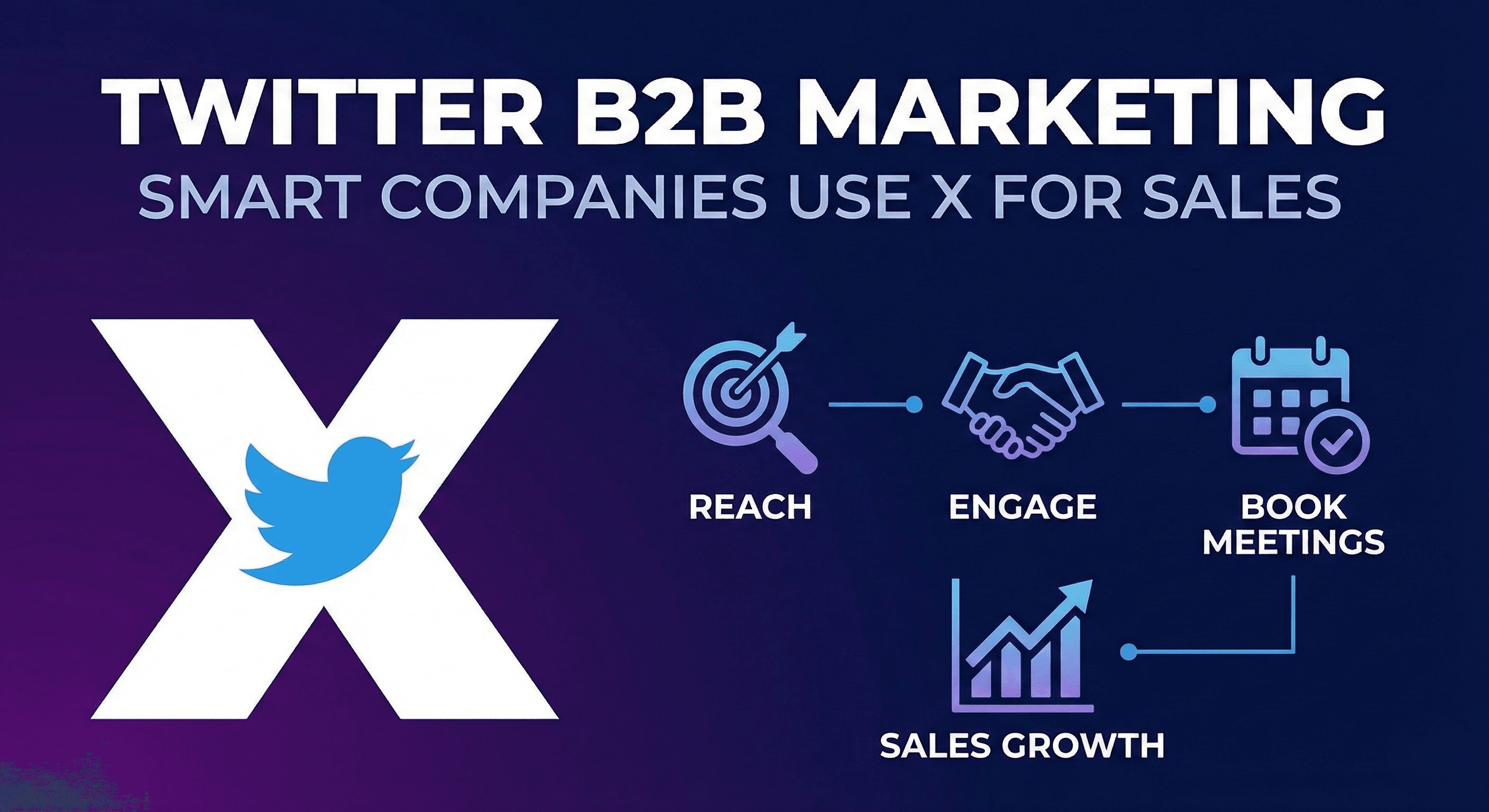
Twitter B2B marketing is the strategic use of X to reach decision makers, catch buying signals in real time, and start sales conversations that other channels miss. It works because executives engage personally on X: founders live-tweet launches, CTOs debate tools, and VPs post their real frustrations. The smartest teams pair that signal with LinkedIn, Instagram, and email so one buyer gets reached on the channel they actually respond to.
This is not about abandoning LinkedIn. It is about recognizing that Twitter B2B marketing fills gaps your other channels cannot. In this guide you will learn why founders, builders, and teams that sell services invest in X for sales, the strategies that work in 2026, and how to build a signal-driven engine that books meetings on autopilot.
Table of Contents
- What is Twitter B2B Marketing?
- Why Smart Companies Choose X for B2B Sales
- Twitter B2B Marketing Strategies That Drive Revenue
- Real-World B2B Success Stories on X
- Twitter vs LinkedIn for B2B: When to Use Each
- Why X Works Best Combined With LinkedIn, Instagram, and Email
- Common Twitter B2B Marketing Mistakes to Avoid
- Tools for Twitter B2B Marketing Success
- Key Takeaways
- FAQ
What is Twitter B2B Marketing?
Twitter B2B marketing is the strategic use of X (formerly Twitter) to reach, engage, and convert business decision makers. Unlike consumer marketing, B2B Twitter marketing focuses on building relationships with the people who influence or make purchasing decisions at companies.
This includes:
- Thought leadership: Sharing insights that position your company as an authority
- Social selling: Building relationships that lead to sales conversations
- Lead generation: Identifying and nurturing prospects through content and engagement
- Customer engagement: Using X for support and deepening customer relationships
- Competitor intelligence: Monitoring conversations about competitors and industry trends
What makes Twitter B2B marketing different from other platforms is the nature of engagement. Twitter is personal. CEOs tweet their real opinions. VPs of Sales share genuine frustrations. CTOs debate technology choices publicly. This transparency creates opportunities for authentic connection that simply do not exist on more polished platforms.
That same transparency is gold for anyone who sells services. If you are a founder, builder, consultant, fractional executive, recruiter, or agency, a single well-timed reply to the right founder is worth more than a thousand cold emails.
Why Smart Companies Choose X for B2B Sales
The Numbers Behind Twitter B2B Success
The data supports what savvy B2B marketers already know: X is an underutilized goldmine.
- 82% of B2B organizations use Twitter to reach their customers
- 85% of SMBs believe Twitter is vital to their online strategy
- 65% of B2B marketers use Twitter for content distribution
- 93% of people who follow small businesses on Twitter plan to purchase from them
- 67% of B2B businesses actively use Twitter as a marketing channel
Yet despite these numbers, most B2B companies treat Twitter as an afterthought, focusing their energy on LinkedIn. This creates an opportunity: lower competition and higher visibility for those who take Twitter B2B marketing seriously.
Decision-Makers Are Personally Active
Here is what makes Twitter unique for B2B sales: executives personally engage on the platform.
On LinkedIn, many C-suite profiles are managed by assistants or marketing teams. Posts are carefully crafted, comments are vetted, and direct messages go unanswered for weeks.
On Twitter, it is different. Founders live-tweet their product launches. CEOs engage in debates about industry trends. VPs share their genuine takes on market shifts. When you reply to their tweet or send a DM, there is a real chance they see it themselves.
This direct access is invaluable for B2B sales teams. Instead of trying to get past gatekeepers, you are building relationships with decision makers in their natural habitat.
Real-Time Engagement Creates Opportunities
Twitter's real-time nature is a superpower for B2B marketing. You can:
- Spot buying signals as they happen ("Looking for recommendations on project management software")
- Engage with prospects when they are most active and receptive
- React to industry news and position your company as a thought leader
- Identify unhappy competitor customers and offer alternatives
Unlike email outreach that sits in inboxes for days, Twitter conversations happen now. A well-timed reply or DM can start a sales conversation before your competitors even notice the opportunity. This is the core idea behind signal-driven outbound: timing beats messaging, and X is where intent surfaces first.
Lower Cost, Higher ROI
B2B companies report 40% greater ROI from Twitter compared to other social channels. Why?
- Organic reach still works: Unlike Facebook, organic content on X can still reach significant audiences
- Engagement is cheaper: Twitter ads cost less than LinkedIn ads for B2B targeting
- The sales cycle is faster: Real-time conversations accelerate deal velocity
- Content is easier to create: Twitter's short-form format requires less production overhead
Twitter B2B Marketing Strategies That Drive Revenue
1. Establish Thought Leadership Through Content
The foundation of Twitter B2B marketing is valuable content. But "valuable" on Twitter looks different than other platforms.
What works on X:
- Hot takes: Contrarian views that spark discussion
- Thread breakdowns: Educational content in a scannable format
- Behind-the-scenes insights: Real numbers, real challenges, real lessons
- Industry commentary: Quick reactions to news and trends
- Curated wisdom: Sharing and adding context to others' content
The 60/40 content rule:
- 60% original content (your insights, data, experiences)
- 40% curated content (industry news, others' posts with your commentary)
Consistency matters more than perfection. Aim for 3 to 5 tweets per day, and remember: Twitter rewards accounts that post regularly with focused topical expertise.
2. Use Social Listening to Find Buyer Intent
Smart Twitter B2B marketing goes beyond posting content. It involves actively listening for signals that indicate buying interest.
Monitor for:
- Direct requests: "Anyone recommend a good CRM for startups?"
- Frustration with competitors: "So frustrated with [Competitor]. Looking for alternatives"
- Problem statements: "We are struggling to scale our outreach without burning out our SDRs"
- Industry hashtags: #SaaS, #B2BSales, #MarTech, and niche-specific tags
When you spot these signals, do not immediately pitch. Add value first. Answer questions, share resources, or simply engage with their other content. Build the relationship before asking for anything.
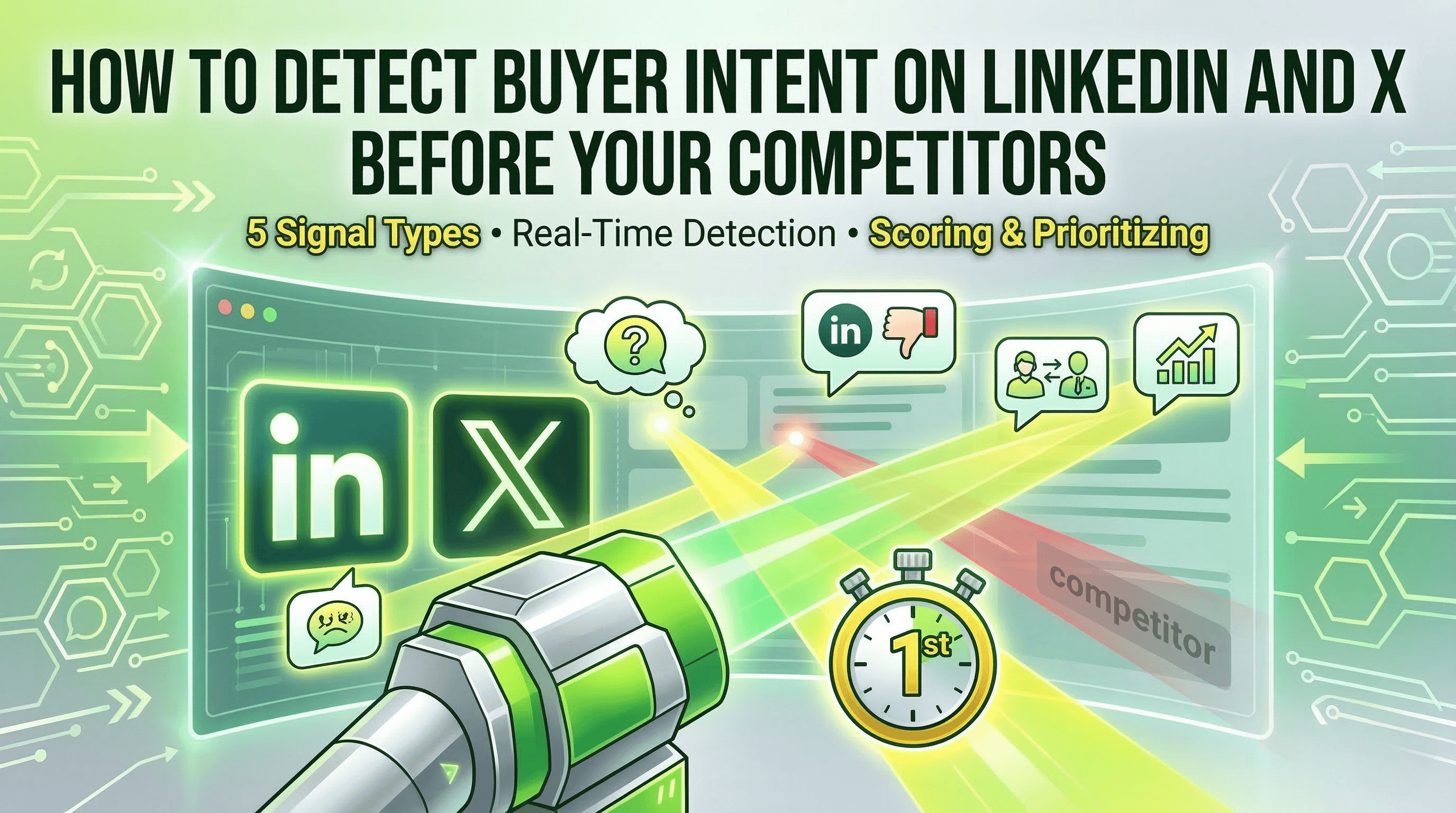
Modern tools can automate this monitoring, alerting you when prospects tweet about problems your product solves. This is social listening at scale, and it is one of the most effective Twitter lead generation strategies available. Learning how to detect buyer intent on LinkedIn and X before your competitors is what separates a meeting-booking machine from a content account.
3. Build Relationships Before Selling
The biggest mistake in Twitter B2B marketing is pitching too soon. X rewards relationship-building, not cold outreach.
The warm-up strategy:
- Week 1 to 2: Like and retweet their content regularly
- Week 2 to 3: Leave thoughtful replies on their tweets
- Week 3 to 4: They start recognizing your profile picture
- Week 4 and beyond: Now your DM is warm, not cold
This approach increases DM response rates dramatically, from approximately 5% (cold) to 25 to 40% (warm). When someone already recognizes your name from their notifications, they are far more likely to engage with your outreach. For a full playbook, see how to warm up your Twitter account before outreach.
4. Leverage DMs as a Sales Channel
Twitter DM automation has evolved far beyond basic auto-messages. Modern approaches combine relationship warm-up, personalization, and intelligent conversation handling.
What works in B2B Twitter DMs:
- Reference something specific from their recent tweets
- Lead with value, not a pitch
- Keep initial messages short (3 to 4 sentences)
- Have a clear but soft call-to-action
- Use conversation, not templates
What to avoid:
- Generic messages that could be sent to anyone
- Links in the first message
- Aggressive follow-up sequences
- Pitching before establishing any rapport
For detailed guidance on how to automate Twitter DMs without getting banned, the key is mimicking human behavior: gradual scaling, genuine engagement alongside automation, and personalized messaging.
5. Target Competitor Audiences
Your competitors have already built an audience of your ideal customers. Smart Twitter B2B marketing leverages this.
Strategies for ethical audience targeting:
- Extract competitor followers: Identify users who follow your main competitors
- Analyze engagement: Focus on users who actively engage (like, reply, retweet) not just passive followers
- Monitor complaint threads: When someone complains about a competitor, that is a warm lead
- Engage their community: Participate in conversations your competitors' followers are having
This is not about stealing customers. It is about serving an audience that is already interested in solutions like yours. If you want the mechanics, here is how to extract followers from any Twitter account for lead generation.
Real-World B2B Success Stories on X
Slack: Customer Service as Marketing
Slack transformed Twitter into a support and marketing channel simultaneously. Their strategy combines:
- Relatable content about work-life and collaboration
- Rapid response to customer questions and issues
- Integration highlights showing platform versatility
- A friendly, approachable brand voice
The result? Slack's engagement rate among B2B buyers increased by 41% for posts featuring customer stories, and product demos requested by enterprise teams grew 21% within three months.
Buffer: Education-First Approach
Buffer built 264,000+ followers with a strategy focused entirely on value. Their feed reads like a how-to guide for social media marketing, with virtually no direct product promotion.
By leading with education, Buffer established trust that converts to product trials organically. Followers do not feel sold to. They feel helped.
Maersk: Making "Boring" Industries Interesting
Global shipping company Maersk proves any B2B industry can succeed on Twitter. With 112,000+ followers, they share stunning HD images of their fleet traveling to remote corners of the world.
Instead of talking about logistics and shipping rates, they tell stories. This humanized approach makes a traditional industry engaging and shareable.
GoToMeeting: Community Over Promotion
GoToMeeting fills their Twitter feed with actionable content from parent company Citrix and industry-relevant sources. The result is a community that values education over promotion, plus 50,000+ followers who trust the brand.
Twitter vs LinkedIn for B2B: When to Use Each
Smart B2B marketers do not choose between Twitter and LinkedIn. They use both strategically.
| Factor | Twitter/X | |
|---|---|---|
| Audience mindset | Casual, conversational | Professional, formal |
| Content format | Short-form, threads, real-time | Long-form, articles, documents |
| Best for | Thought leadership, engagement, real-time selling | Networking, recruiting, company pages |
| Decision-maker access | Direct, personal accounts | Often managed or delegated |
| Engagement speed | Immediate | Slower, more deliberate |
| Competition | Lower for B2B | Saturated for B2B |
| Lead quality | High intent when using social listening | High volume, variable intent |
| Cost per lead | Lower | Higher |
When to prioritize Twitter B2B marketing:
- Your buyers are active on X (tech, SaaS, startups, marketing)
- You want to build personal brand alongside company brand
- Real-time engagement is important to your sales process
- You are looking for lower-cost lead generation channels
- Your content strategy favors short-form, frequent posting
When to prioritize LinkedIn:
- You are targeting enterprise buyers in traditional industries
- Company-to-company relationships matter more than personal connections
- Your content is long-form and research-heavy
- Recruiting is a priority alongside marketing
The best approach? Use both. Build thought leadership on Twitter, nurture professional connections on LinkedIn, and use insights from each platform to inform the other.
Why X Works Best Combined With LinkedIn, Instagram, and Email
Here is the reality in 2026: no single channel reaches every buyer. The decision maker who ignores your DM on X might reply on LinkedIn. The founder who never opens email lives in their Instagram DMs. Treating X as a silo leaves meetings on the table.
The teams winning at Twitter B2B marketing run X inside one signal-driven sequence that also spans LinkedIn, Instagram, and email. When a prospect tweets buying intent, you can reach them on X, then follow up on LinkedIn, then send a Gmail-to-Gmail email a few days later if they go quiet. Same person, same context, every channel, one timeline.
This matters most for anyone who sells services. Founders, builders, consultants, fractional CFOs and CTOs, recruiters, and agencies are not selling a $20 subscription. They are chasing real relationships, one prospect at a time. For those teams, being present on whichever channel the buyer actually checks is the difference between a booked call and silence.
This is exactly the gap Autoreach closes. It is an AI Buyer Engine that monitors 20+ signal types around the clock with under two minute detection latency, scores every lead by fit, intent, and timing into a single Buyer Score, then runs a cross-channel sequence across LinkedIn, X, Instagram, and email from one place. To date it has scored more than 86,850 leads, with users seeing reply rates around 40% and roughly two meetings booked per day.
You do not have to commit blind. The free, no-login Buyer Signal Scan lets you paste a website and get named decision makers with verified LinkedIn profiles plus a suggested messaging angle per person, in about 20 seconds. It is the fastest way to see whether the buyers you want are actually reachable.
Common Twitter B2B Marketing Mistakes to Avoid
Mistake 1: Treating Twitter Like LinkedIn
Twitter is not LinkedIn with shorter posts. The platforms have fundamentally different cultures.
On LinkedIn, polished and professional wins. On Twitter, authentic and opinionated wins. If you sound like a corporate press release on X, you will be ignored.
Fix: Develop a distinct Twitter voice. Share opinions. Engage in debates. Show personality.
Mistake 2: All Promotion, No Value
Nobody follows a brand to see product announcements. They follow for insights, entertainment, or utility.
The ideal ratio:
- 80% value (education, insights, entertainment)
- 20% promotion (product updates, offers, CTAs)
Even that 20% should be wrapped in value: case studies, customer stories, and results rather than feature lists.
Mistake 3: Ignoring DMs as a Sales Channel
Many B2B companies use Twitter only for broadcasting content. They are missing the real opportunity: direct conversations.
Twitter DMs have 30-40% open rates compared to 20-25% for cold email. When done right, with personalization and warm-up, they are one of the most effective outreach channels available.
Mistake 4: Inconsistent Posting
Twitter's algorithm rewards consistent activity. Posting heavily for a week then disappearing hurts your reach.
The solution: Use scheduling and automation tools to maintain a consistent presence, even when you are busy with other priorities.
Mistake 5: Not Engaging with Others
Twitter is a conversation platform. If you only broadcast and never engage, you are using it wrong.
Spend as much time replying to others as you do posting your own content. This builds relationships and increases your visibility. Tools with a Growth Loop Engine can run this for you: outbound AI agents post, comment, like, and follow in your niche, while inbound AI agents capture anyone who engages, enrich and score them, and auto-enroll qualified people into outreach.
Tools for Twitter B2B Marketing Success
For AI-Powered Sales Automation
Autoreach is built specifically for founders, builders, and teams that sell services and want to turn X into a meeting-booking machine. Unlike basic DM tools, Autoreach functions as a complete AI Buyer Engine:
- Signal detection: Monitor 20+ signal types 24/7 (pain points, hiring spikes, funding, tool-evaluation chatter, role changes) with under two minute latency
- Lead extraction: Pull targeted leads from any X account or competitor audience
- Lead scoring: Score every prospect by fit, intent, and timing into one Buyer Score
- Automated warm-up: Build relationships with likes and replies before outreach
- Glass-box AI conversations: A Conversation Simulator lets you see and edit every AI reply before it sends, A/B test prompts, and train the voice on your past best DMs
- Cross-channel sequencing: Run X alongside LinkedIn, Instagram, and email in a single sequence
- Meeting booking: Qualify prospects and schedule calls automatically
It ships in two modes: Autopilot (a fully automated web app) and Copilot (a Chrome extension that reads your live X and LinkedIn DMs and suggests replies in real time). Account safety is built in with browser-grade TLS fingerprinting, per-account behavioral profiles, human-like delays, automatic cooldowns, and an optional dedicated ISP proxy ($15/mo). For teams serious about Twitter B2B marketing at scale, Autoreach eliminates the manual work while keeping the personalization that gets results. See it in action in this guide to booking meetings on autopilot with AI.
Autoreach pricing at a glance
| Plan | Price | What you get |
|---|---|---|
| Self-Serve | $99/month | All platforms (LinkedIn, X, Instagram, email), all features, AI credits included, or bring your own key (no markup). Optional dedicated proxy $15/mo. Need more accounts? Talk to us |
| Done-For-You | $299 setup + $200/meeting booked | The Autoreach team sets everything up in one 30-minute call and runs Autoreach for you across all platforms. You pay $200 per meeting booked, nothing else until meetings happen |
At $99/month, Autoreach is not trying to be the cheapest DM tool. It is trying to replace your whole stack. Lead discovery, signal detection, warm-up, multi-channel sequencing, AI conversations, and meeting booking usually mean buying 3 or 4 separate point tools that together cost far more than $99. A dedicated ISP proxy is an optional $15/month add-on at cost (competitors often charge marked-up extra or make you bring your own), and AI is included to start, and if you bring your own OpenAI or Anthropic key there is no markup (about $50/month in AI cost on your own key). Set up in 30 minutes, cancel anytime.
For Content and Scheduling
- Tweet Hunter: Content inspiration, scheduling, and auto-DM on engagement (see our Tweet Hunter alternative)
- Hypefury: Thread scheduling and engagement automation
- Buffer: Simple scheduling across platforms
For Analytics
- Twitter Analytics: Built-in metrics for followers and engagement
- Sprout Social: Cross-platform analytics with Twitter insights
- Hootsuite: Enterprise-grade social monitoring
Key Takeaways
- Twitter B2B marketing reaches decision makers directly. Executives engage personally on X, so a well-timed reply or DM can start a real conversation without going through gatekeepers.
- Timing beats messaging. X is where buying intent surfaces first. Catching signals in real time and acting within minutes outperforms cold-list spray.
- X works best combined with other channels. Run X inside one signal-driven sequence with LinkedIn, Instagram, and email so you reach each buyer where they actually respond.
- Anyone who sells services benefits most. Founders, builders, consultants, fractional execs, recruiters, and agencies win when they reach the right buyer at the right moment, so channel presence beats raw volume.
- All-in-one beats a stack of point tools. Autoreach combines discovery, signal detection, warm-up, multi-channel sequencing, glass-box AI conversations, and booking for $99/month with an optional dedicated proxy ($15/mo) and no AI markup.
- Warm before you pitch. Likes, replies, and engagement lift DM response rates from roughly 5% cold to 25 to 40% warm.
Frequently Asked Questions
Is Twitter B2B marketing still effective in 2026?
Yes. With 82% of B2B organizations using Twitter and 93% of SMB followers planning to purchase, X remains a powerful B2B channel. The key is using modern strategies: signal detection, relationship building, AI-powered automation, and following up across other channels rather than outdated spray-and-pray tactics.
How does Twitter compare to LinkedIn for B2B leads?
LinkedIn generates more overall B2B leads (about 80% of social B2B leads), but Twitter offers advantages: lower competition, more personal access to decision makers, real-time engagement, and lower cost per lead. Smart B2B marketers use both platforms together, and increasingly add Instagram and email to the same sequence.
Does it work on Instagram and email too?
Yes. Modern outbound runs across four channels in one sequence: LinkedIn, X, Instagram, and email (Gmail and Outlook, with smart routing for deliverability). Autoreach reaches the same buyer on whichever channel they actually respond to, all tracked in one timeline so nothing gets duplicated or dropped.
How much does Twitter B2B marketing automation cost?
Autoreach is $99/month for the Self-Serve plan, which includes all platforms (LinkedIn, X, Instagram, and email) and every feature, with no per-account add-on fee. A dedicated proxy is an optional $15/month add-on at cost. You bring your own AI key with no markup (typically about $50/month in AI cost). A Done-For-You option is $299 setup plus $200 per meeting booked: the Autoreach team sets everything up in one 30-minute call and runs Autoreach for you across all platforms, and you pay nothing else until meetings happen. Set up takes about 30 minutes and you can cancel anytime.
How often should B2B companies post on Twitter?
Aim for 3 to 5 tweets per day, including a mix of original content, curated posts with commentary, and engagement with others' content. Consistency matters more than volume. Regular posting beats sporadic bursts.
Can I automate my Twitter B2B marketing?
Yes, when done correctly. Modern tools can automate lead discovery, warm-up engagement, DM outreach, and even conversations. The key is maintaining personalization and avoiding spam-like behavior that gets accounts flagged. Tools like Autoreach use browser-grade TLS fingerprinting, human-like delays, and a dedicated ISP proxy to stay safe.
What is the best time to post on Twitter for B2B?
Generally, weekday mornings (8 to 10 AM) and lunch hours (12 to 1 PM) in your target timezone perform best for B2B. However, use your analytics to identify when your specific audience is most active.
How do I measure Twitter B2B marketing success?
Track engagement rate (aim for 0.5 to 1% or higher), profile visits, follower growth, DM response rates (25 to 40% for warm outreach), meetings booked, and pipeline generated from Twitter-sourced leads.
Start Your Twitter B2B Marketing Strategy Today
Twitter B2B marketing is not about replacing your other channels. It is about accessing decision makers in a way that email and LinkedIn alone cannot match, then following up everywhere they actually respond. The companies seeing the best results combine thought leadership content, signal detection, relationship-first engagement, and smart cross-channel automation.
Here is your action plan:
- This week: Audit your X presence and optimize your profile for B2B
- This month: Establish a consistent posting schedule and engagement routine
- This quarter: Implement signal detection to identify buyer intent across channels
- Ongoing: Scale with AI-powered automation while maintaining authenticity
Try Autoreach, the AI Buyer Engine that detects buying signals across LinkedIn, X, Instagram, and email, scores every lead by fit, intent, and timing, runs cross-channel sequences, and books meetings on autopilot. One plan, every feature, an optional dedicated proxy (activation included, then $15/mo), and AI included to start. $99/month, set up in 30 minutes, cancel anytime.
Tags
Ready to find buyers worth contacting this week?
Autoreach detects buying signals across LinkedIn, X, Instagram, and email, then books meetings on autopilot.